Bestiarium
Placing the real and the fantastical on the very same level.
Directed by Luigi Grispello
words by Katie Huelin
Directed by Luigi Grispello, Bestiarium draws inspiration from medieval bestiaries, those enchanting manuscripts where real and mythical creatures are granted equal truth. Here, that catalogue is reborn on film.
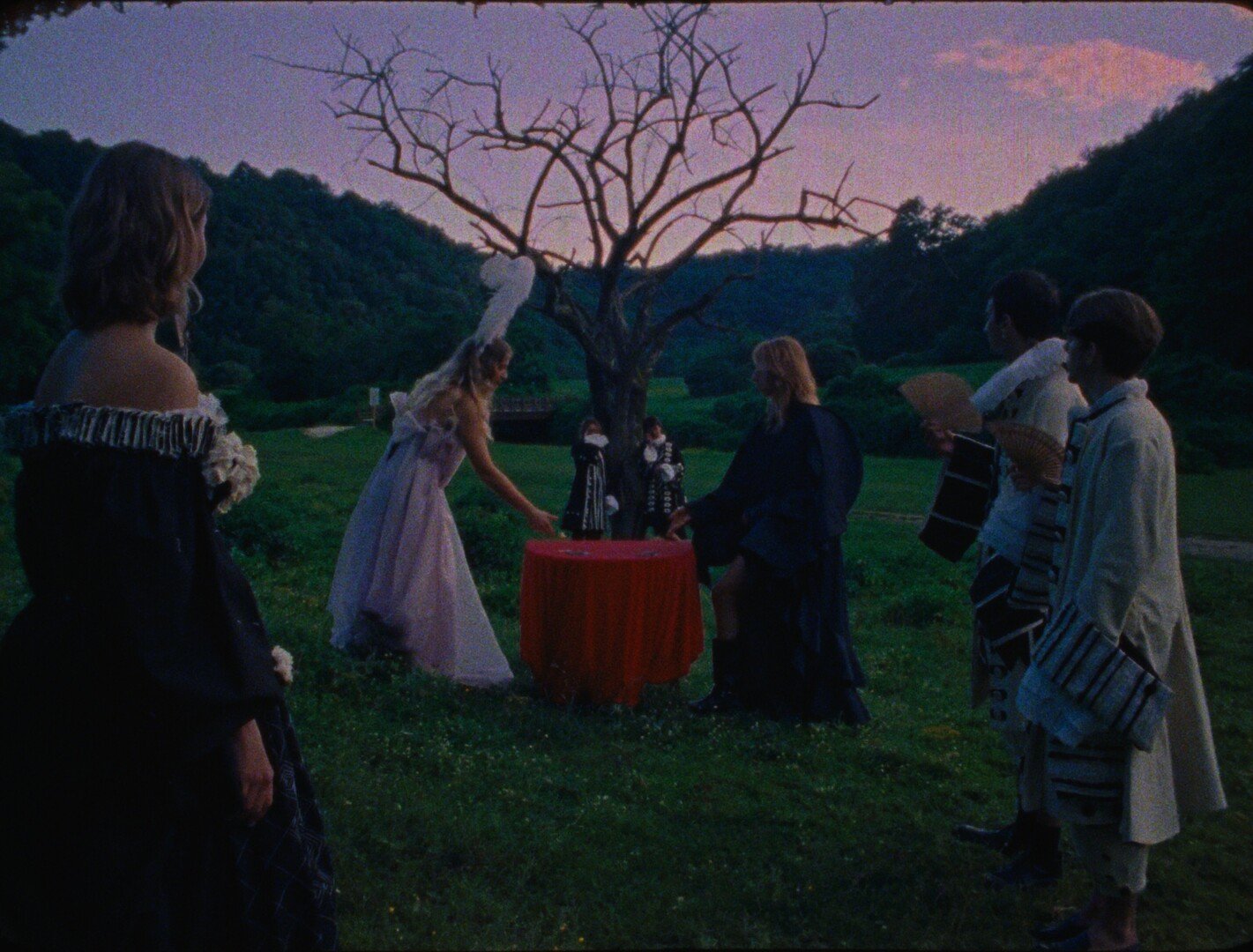
We enter a hidden ecosystem where fashion and folklore collide, where bodies evolve into something more than human. Shot beautifully on film, Bestiarium invites us into a world that feels both sacred and forbidden, a universe that exists in balance until we arrive.
Hybrid forms. Metaphysical beauty. Cinema as myth-making.
What drew you to reinterpret the medieval bestiary through film and how did you want your own “Bestiarium” to feel alive on screen?
Medieval bestiaries have the unique charm of placing the real and the fantastical on the very same level. They blur the line between truth and fiction, just like cinema and magic do. They catalogue a third, liminal world. My intention was precisely to create a document—not on paper but on film—coming from a dimension different from our own. We wanted the viewer to feel like a reader discovering an ancient forbidden book that hides a concealed universe. That voyeuristic act of peeking makes us desire that world—and perhaps we even want to possess it—but our interaction risks breaking a fragile balance.
There’s a hypnotic tension in the film, between the natural and the surreal, the human and the creaturely. How did you approach creating this hybrid atmosphere through image, sound, and movement?
In the world illustrated by the bestiary, nature and culture, human and animal, reality and magic coexist perfectly; there is no conflict, only balance—at least until the visitors arrive. From this idea came the choice of film stock: a chemical support capable of imprinting the image like a long alchemical parchment. The soundtrack turns noises into music and music into noises. And finally, the graceful, harmonious movements of the models and the camera complete this hybrid atmosphere.
“I believe language is the primary key to accessing a world and a society.”
The film’s visual world feels tactile: from the saturated textures of the costumes to the way light hits the skin and foliage. Can you share with us how you made these aesthetic choices - from palette to format, to the 16mm grain - that define Bestiarium?
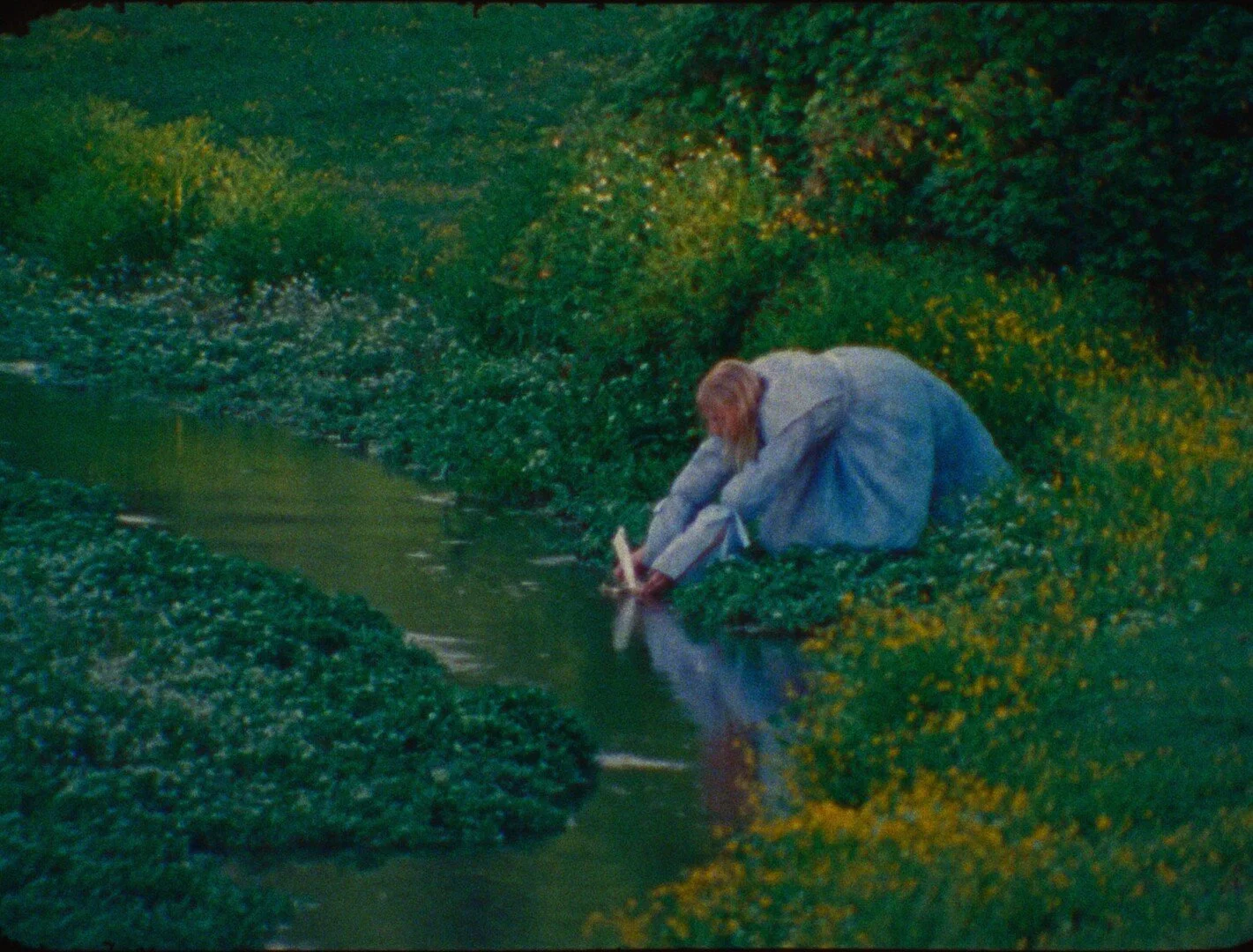
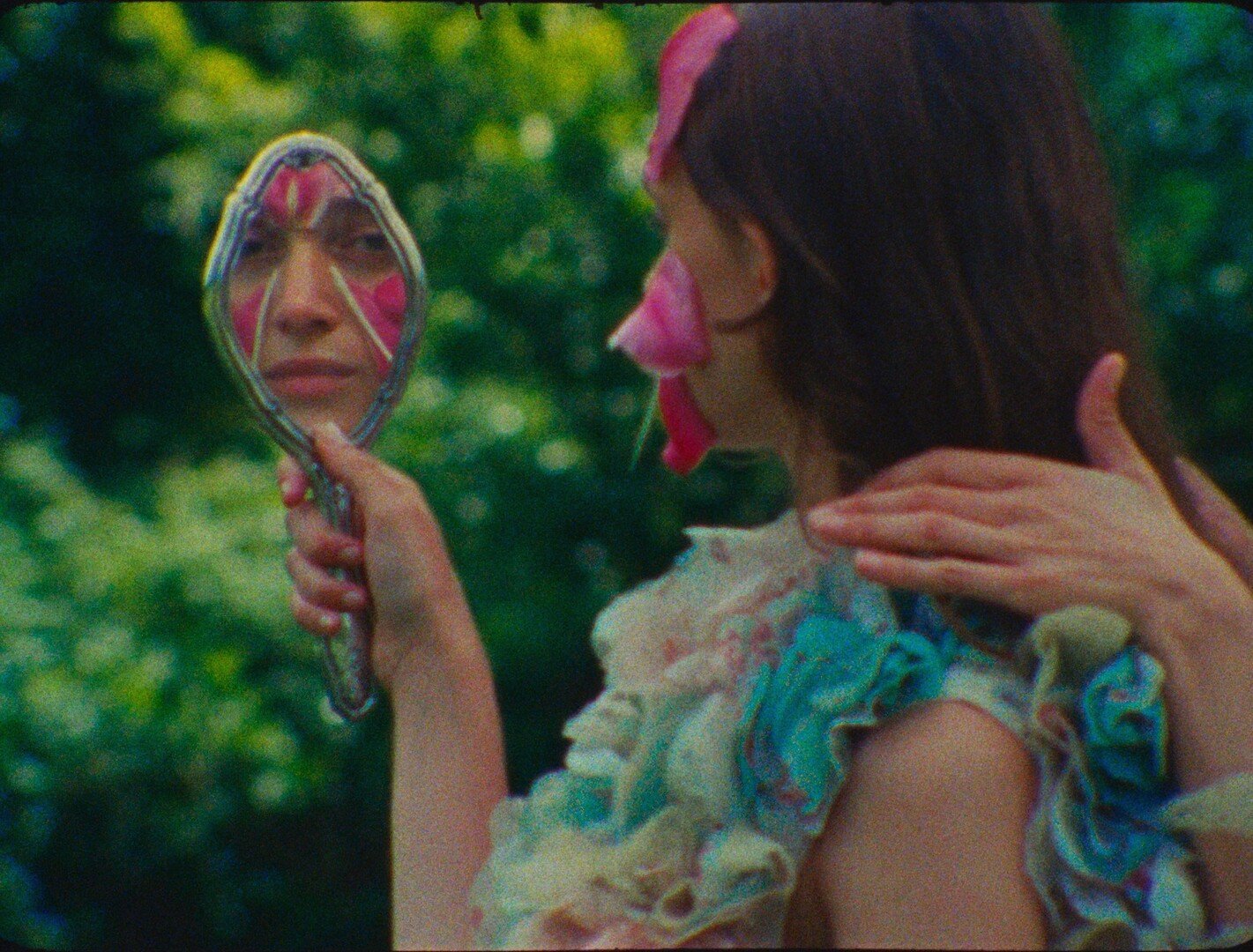
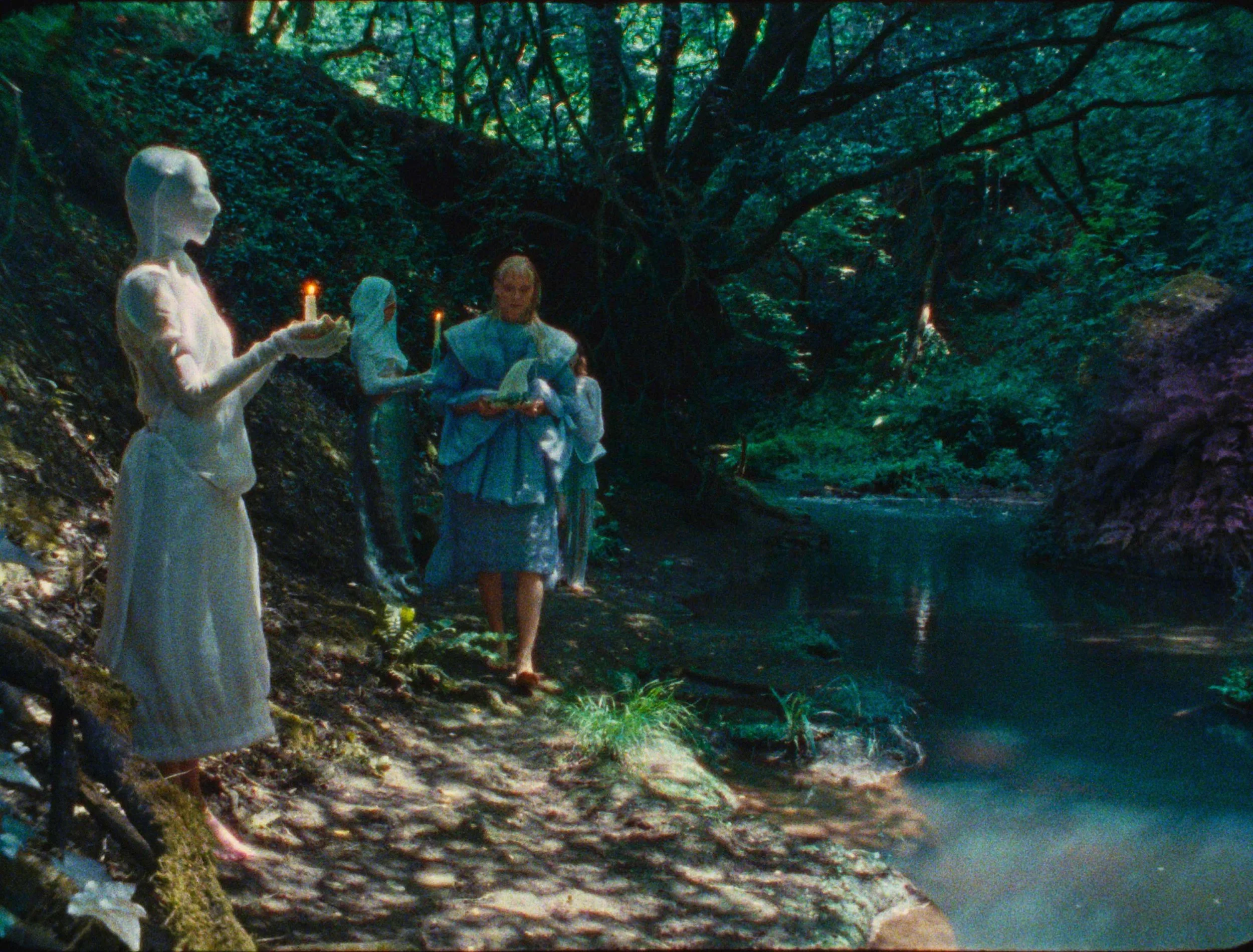
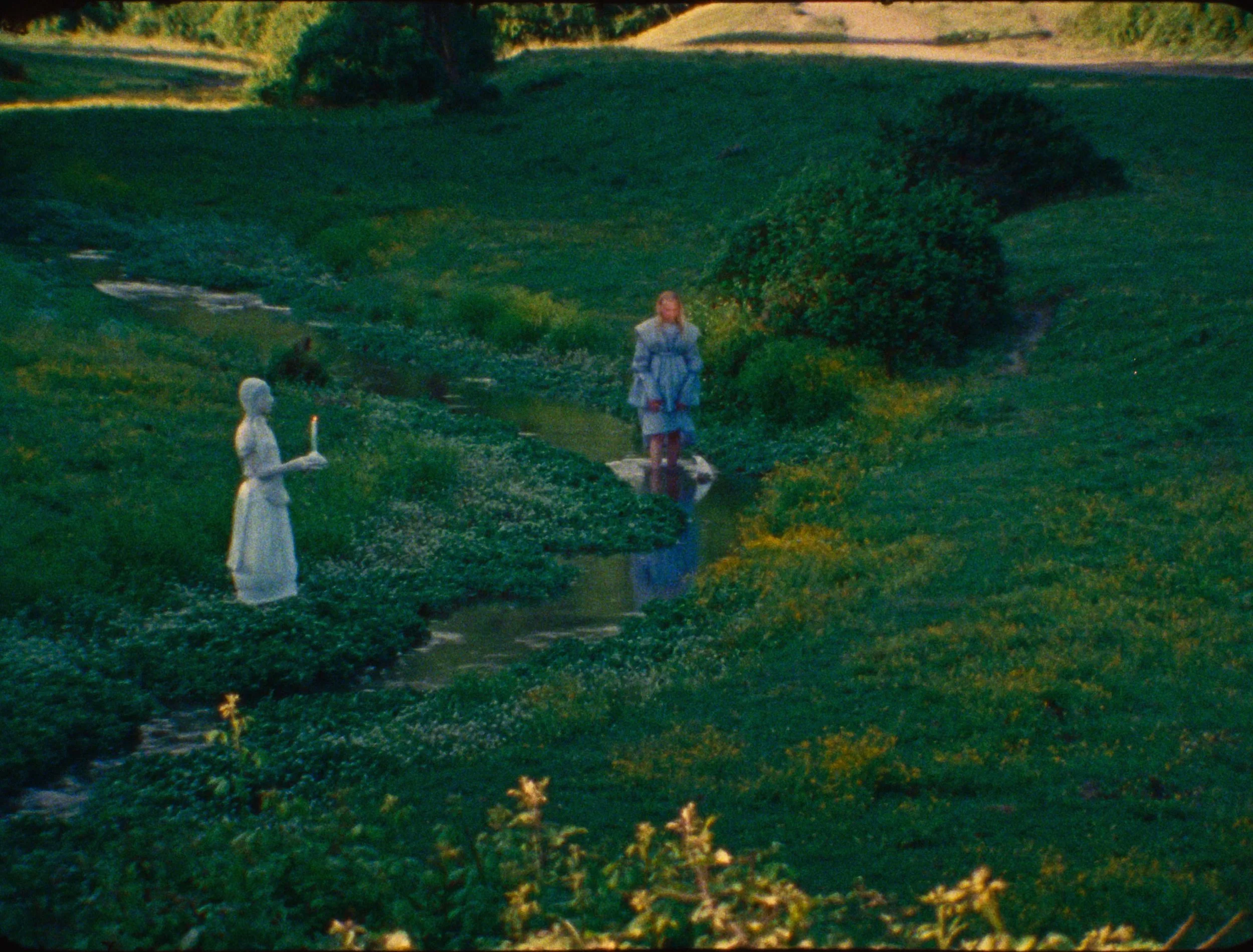
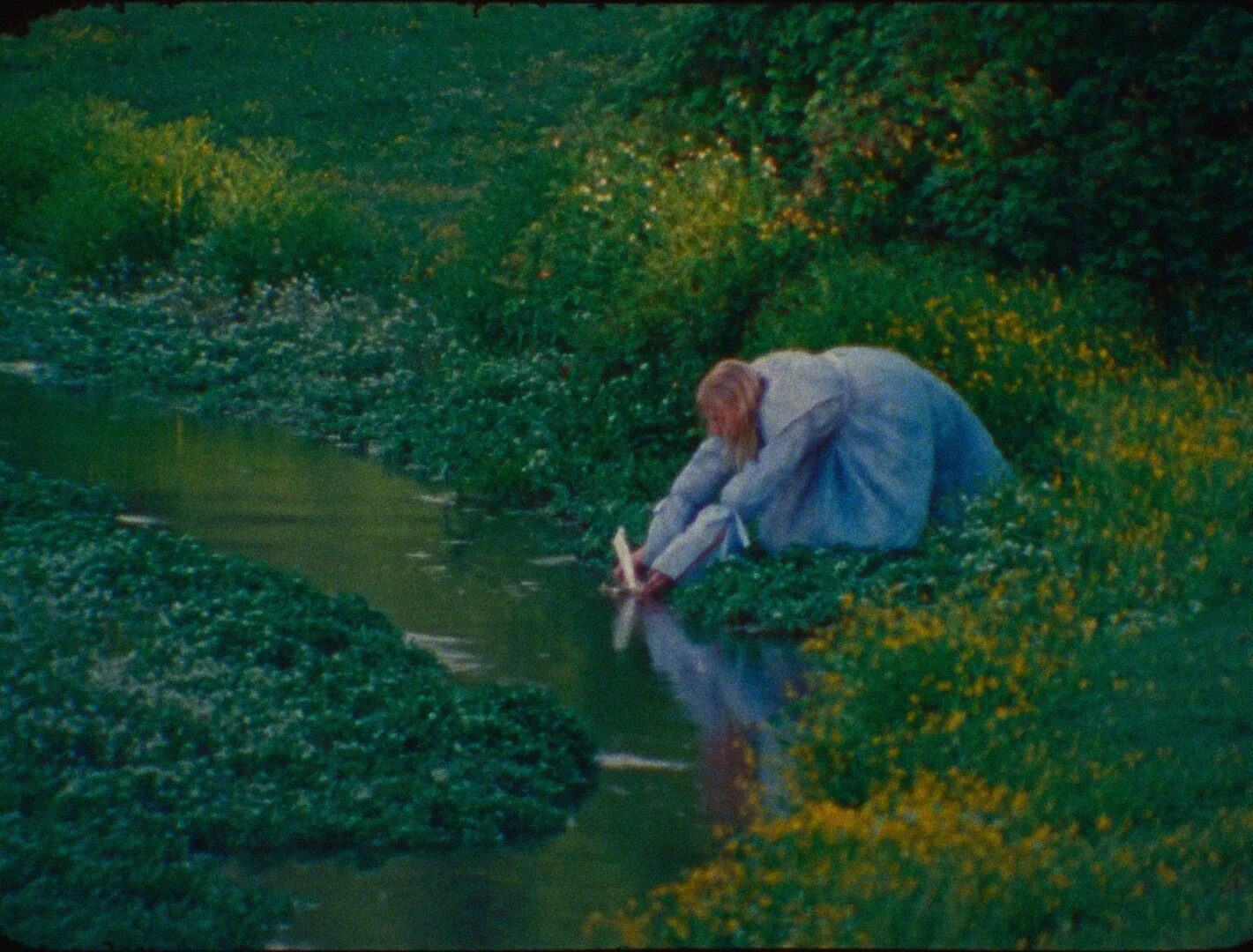
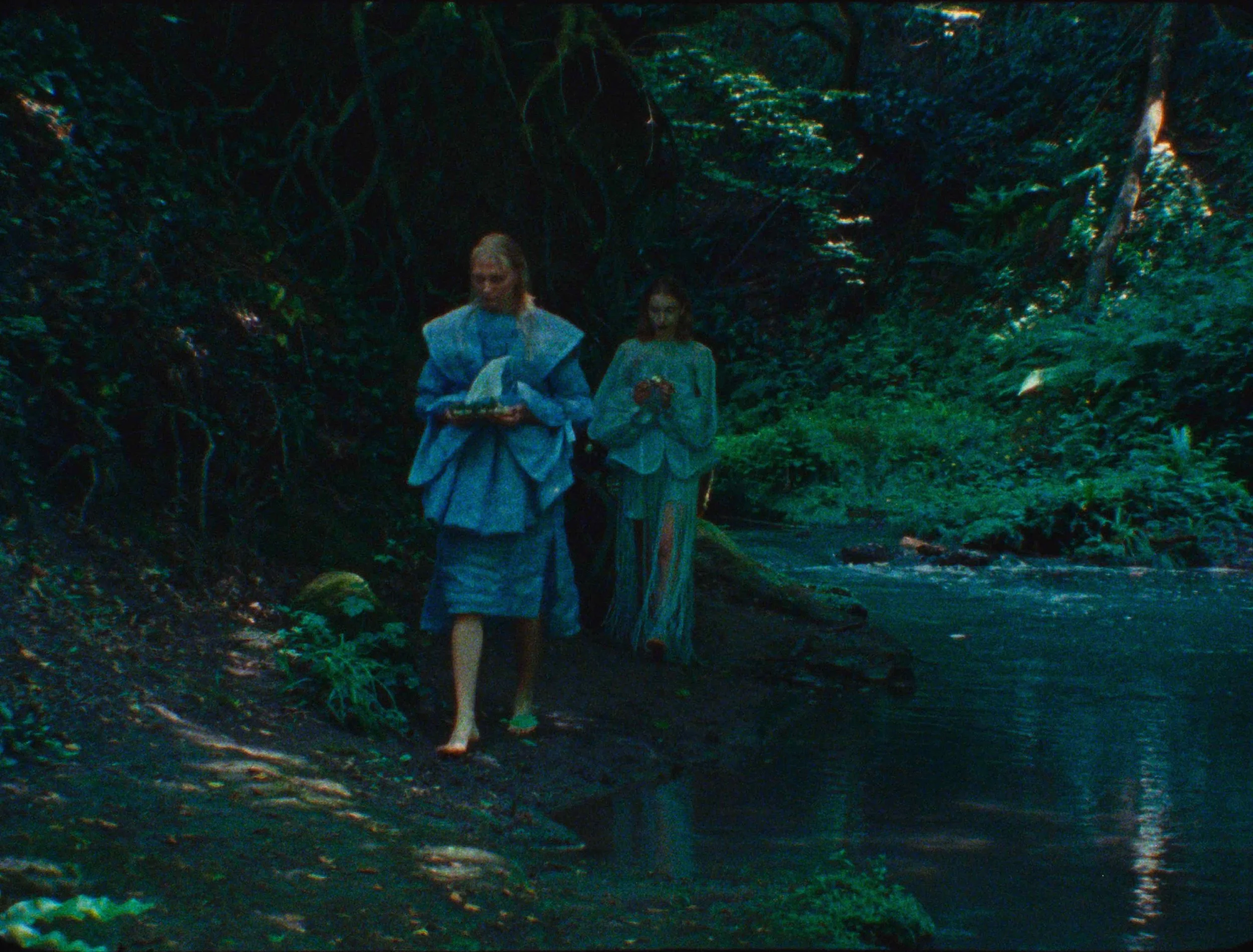
The world of Bestiarium, unlike our own, exists in perfect harmony with nature, and we wanted these metamorphic and hybrid creatures to embody that connection, as if they had emerged from the trunk of a tree, been born from stream water, or bloomed in a meadow. Everything recalls nature: the costumes, the make-up, the set design, the locations, the props, and the light. In fact, the entire film was shot using only natural light. With Bernardo Massaccesi (the cinematographer), we carefully selected the ideal phases of sunlight for each shot, using only the sun, mirrors, or refractions of daylight to illuminate the scenes.
In this same vein, we chose to work with film stock—a material, dusty support, like an old manuscript.
As for color, despite shooting on film, we carried out an important color correction process. The palette draws from the saturated hues of medieval miniatures, and together with the colorist (Andrea Sabatelli) and the cinematographer, we even altered the colors of the plants and vegetation, as if it were a world based on the real one, but reimagined and recolored by a miniaturist.
You chose to use Latin as the film’s language. What role does language, or the abstraction of it, play in how you construct meaning in your work?
I believe language is the primary key to accessing a world and a society, and since I am interested in portraying ways of life different from my own, whether real or imagined, I always build the narrative upon linguistic foundations.
The choice of Latin has several motivations. The first is historical and philological: bestiaries were written in Europe during the Middle Ages, at a time when Latin was the predominant written language. And since much of the fantasy imagination draws from that era, Latin has often been used (as in Rowling’s work, for example). Moreover, Latin is a dead language, which gives it an additional mystical and secret aura—one that I tried to emphasize through fonts that are intentionally difficult to decipher.
Your previous films explore the boundaries between anthropology and imagination. Do you see Bestiarium as a continuation of that exploration?
Yes, with one key difference: here I began with imagination and then constructed a society around it, with its rituals, uses, and customs. Usually, my process starts with anthropological research, and only afterwards do I add the fantastical element.
This is your first fashion film. How did working within that framework, where fabric and atmosphere often carry more weight than narrative, influence the way you thought about directing?
I immediately fell in love with this “genre,” because it has few codes and rules, which allows for great creative freedom. Since making Bestiarium, I often exchange ideas with the cinematographer about possible future fashion films. Fashion film is a wonderful laboratory for cinematic experimentation.
What’s next for you?
I’m currently working on a documentary, a short film, and a feature fiction film. Unfortunately, I’m not working on a new fashion film at the moment, but I would love to add one to my upcoming projects.
CREDITS BESTIARIUM
Scriptum et directum: Luigi Grispello
Magister Photographiae: Bernardo Massaccesi
Vestium Compositio: Teresa Iuso, Lorenzo Mecozzi
Moderatio artis: Teresa Iuso, Lorenzo Mecozzi, Luigi Grispello, Bernardo Massaccesi, Giulia
Maci, Martina Pierbattista, Giulia Ponessi, Caterina Passariello
Musica composita: Dario Tolazzi, qui vocatur Tolansky
Temperatio et perfection sonorum: Gianluca Gallo
Scaenographia: Elena Boccuzzi, Lorenzo Mecozzi
Adiutor operatoris: Jacopo Cerroni
Subadiutrix operatoris: Francesca Tascio
Tiro machinae cinematographicae: Giordana Meo
Montatio: Luigi Grispello
Correctio colorum: Andrea Sabatelli
Adiutrix regiae: Eleonora Sardi de Letto
Tiro regiae: Bianca Bernardini
Vestimenta: Filippo Radin, Elena D’Amico, Ka, Margareta Kleeberger, Matteo Testaì, Gabriele
Conti, Keerti Mudaliar, Paula Koivisto Nevado
Vestimenta Scaenica: Flavia Di Leonardo, Laia Bombelli, Elisa Miragliotta, Elisabetta Crivello,
Martina Seveso, Marchesini Cecilia, Bussani Giacomo, Filippo Tammaccaro, Lina Nadtochei
Medicamina faciei et compositio capillorum: Beatrice Vallone, Giulia Mercuri, Chiara Ferretti,
Penelope Gheda
Indutrices et indutores: Sofia Conti, Maria Jelmini, Emma Toussain, Olivia Mevel, Chiara
Alberico, Olivia Cosentini, Federico Videtta, Celeste Mangano, Guendalina Rosselli, Olivia
Maspes, Olivia Cartenì, Ludovica Marra, Maria Vittoria Paglino, Benedetta Boidi, Mario Giordano,
Emma Valerio, Marco Coppetti, Federico Caron
Productio: Teresa Iuso, Lorenzo Mecozzi, Eleonora Sardi De Letto, Giulia Maci, Martina
Pierbattista, Giulia Ponessi, Caterina Passariello
Electio Actorum: Teresa Iuso, Lorenzo Mecozzi, Giulia Maci, Martina Pierbattista, Giulia Ponessi,
Caterina Passariello
Exploratio locorum: Luigi Grispello, Bernardo Massaccesi, Teresa Iuso, Lorenzo Mecozzi
Gratias
Indutrices et indutores: Elettra Palmegiani, Clara De Cinque, Duccio Taviani, Amanda Bortot,
Alessandro Cammarata, Gemma Li Zunni
Vestimenta: Giulio Darpino, Giulia Masi