RUINS WITHIN RUINS
A choreographed excavation of memory, ritual, and fractured identity across the landscapes of Crete
Directed by Lefteris Parasyris
words by Isabella Bazoni
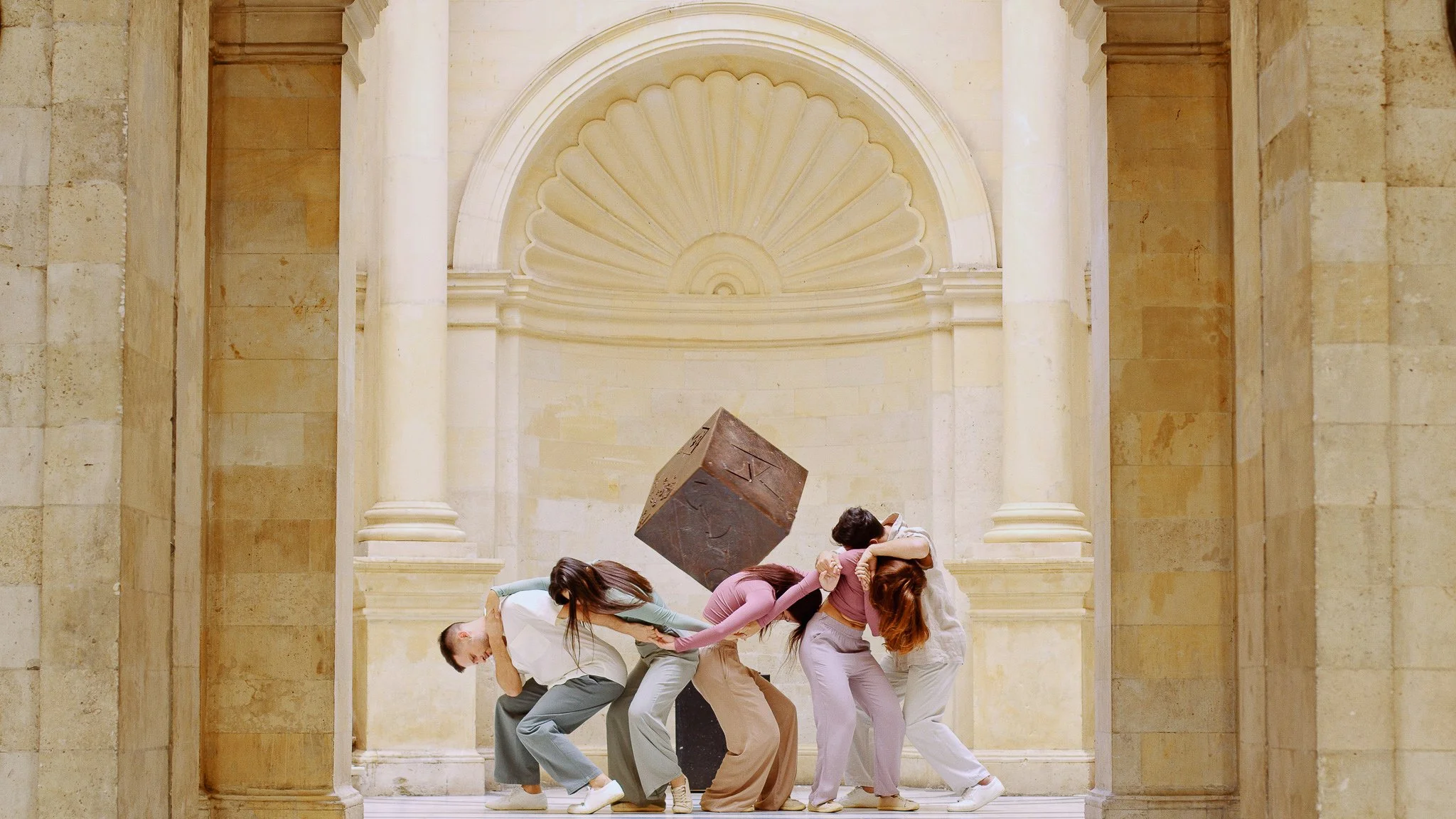
In Ruins Within Ruins, director Lefteris Parasyris turns the landscapes of Crete into something caught between memory, ritual, and performance. Set across ancient ruins and abandoned modern sites, the film follows a group of dancers moving through the island like fragments of a shared history — bodies gathering, separating, and reforming against stone, dust, and open land. The ruins are never treated as symbols or backdrops. Instead, Parasyris approaches them as living spaces shaped by time and human presence. Wind, concrete, skin, and fabric all carry equal weight within the frame, creating a film that feels tactile and deeply physical. There’s a constant push and pull between stillness and movement, tradition and reinvention, as the choreography shifts between gestures that feel inherited and others that feel entirely unfamiliar.
Created in collaboration with choreographer Dimitra Daskalaki, the movement language draws loosely from folk dance without ever becoming literal. The dancers move collectively through the landscape, forming fleeting sculptural images that at times feel ancient, at others strangely futuristic. Throughout the film, movement becomes a way of holding memory, something carried through bodies rather than spoken aloud.
Cinematographers Yorgos Bobolakis and Haris Doukakis capture Crete with a stark, elemental quality, balancing expansive landscapes with intimate details and textures. The score by Venus Volcanism and In Atlas feels embedded within the environment itself, blending with breath, footsteps, and ambient sound to create something immersive and hypnotic.
Like much of Parasyris’ work, Ruins Within Ruins circles ideas of belonging, heritage, and displacement, but it does so without forcing meaning or narrative. Instead, the film lingers in atmosphere, gesture, and repetition, allowing history and identity to emerge gradually through movement and space.
Ruins Within Ruins carries the feeling of bodies searching for connection inside spaces already marked by history. What was the starting image, emotion, or idea that first led you toward making the film?
Ruins Within Ruins started as a photography series. I had been documenting abandoned buildings and ghost villages across Crete, in the aftermath of the Greek financial crisis. Thousands of structures were left unfinished, deserted, or slowly collapsing. What struck me initially was that many of these places were located near — or even within — the ruins of what was once a glorious civilisation. Others stood beside popular tourist destinations that are full of life during the summer, yet become almost empty in the winter.
Ancient ruins carry a sense of mythology and distance — they’ve already been absorbed by time. But these modern ruins feel unresolved, they have not yet weathered or been scavenged by time. Their decay is still fresh and well underway. It was within this paradox that I found the impulse to turn the project into a film.
While standing inside these spaces, where the recent past intersects with the ancient world, I began to feel that stillness alone could not fully express the contradiction I was experiencing — moving through all those layers of history. There was an overwhelming sense of emptiness, memory, and suspended time, and it almost demanded movement. I started imagining bodies inhabiting these locations — not in a narrative way, but as if movement itself could create a dialogue with the spaces. I wanted the dancers to exist at the heart of this paradox, moving between the ancient and contemporary ruins of the island, searching for connection within places already marked by absence and history.
The choreography feels rooted in tradition without ever becoming literal or folkloric. How did you and choreographer Dimitra Daskalaki develop a movement language that could hold both contemporary physicality and echoes of Cretan heritage?
The choreography is contemporary in essence, but draws inspiration from Cretan folk dances and the imagery of Minoan frescoes. We didn’t attempt to recreate folklore, but rather to approach tradition with respect. During the final rehearsals, we gradually began introducing formations and movement patterns that incorporated elements of acrobatics and even breakdance. The aim was to create a visual journey through installations that sometimes harmonise with the landscape and architecture, and at other times clash with them. That’s why the movement language begins in a subtle and fluid way, before unfolding into something more intense and spasmodic. In a sense, the choreography becomes a reflection of the island’s complex heritage and the intricate tapestry of Cretan identity across space and time — from the era of the Minoan civilisation, often regarded as the first in Europe, through the period of Venetian rule and into the present day.
“The ruins are the main character of the film. They dictate the entire narrative and shape the emotional arc of the story.”
The ruins almost behave like another presence within the film, never feeling like a backdrop. How did being inside those locations shape the way you approached framing, movement, and rhythm?
The ruins are the main character of the film. They dictate the entire narrative and shape the emotional arc of the story. These places almost feel like living organisms, carrying their own memory and personal history. Being there often feels like stepping into an altered universe where time moves differently. So you’re left with little choice but to follow their pace — you don’t want to disrupt it. It feels like being a curious child exploring unknown territory. There is awe and enthusiasm, but also a constant sense of awareness. Sometimes you touch a wall that has stood strong for centuries, while in other cases you step onto a floor that feels as though it could collapse at any moment. There is beauty and mystery, but also chaos and destruction. This enduring yet fragile presence of the ruins created the need for the camera to remain still and fixed. It felt important for the frame to observe rather than intervene, allowing the spaces to exist on their own terms. The primary movement comes through the dancers and their interaction with the spaces, as they gradually begin to feel more comfortable within them. At first, the bodies appear cautious, almost hesitant, but over time the movement becomes more instinctive and expansive, as if entering into a quiet interplay with the ruins themselves.
There’s something very tactile about the way you captured stone, wind, skin, and fabric. Were you thinking about texture and physical sensation as a way into memory or identity?
There’s something deeply sensory about these locations. The moment you step into these spaces, you become aware of the dust, the textures, the debris, the broken glass, the exposed metal. There are so many different materials and elements constantly interacting with one another — earth, wind, water, stone, glass, wood, fabric, concrete. All of them establish a certain relationship with the human body and with movement itself.
I’ve always been drawn to cinema that creates a physical experience, where you don’t simply observe a space, but almost feel as though you are inside it. Not just watching it, but experiencing it. Even though Ruins Within Ruins has nothing to do with body horror, I am very interested in the idea of how cinema can make us experience spaces bodily — how a place might smell, how it feels to touch a surface, how the air or the weather affects the body or the skin. Not just what it means to be present in a space emotionally, but what it means to exist within it physically. And that’s something I’d really like to explore further in the future. That relationship became central to the costumes as well. It felt important not to invade these spaces, but to exist within them gently — to explore them, understand them, and develop a kind of quiet connection with them. The fabrics therefore had to feel as though they belonged to the environment rather than interrupt it. That’s why we were drawn to earthy and muted tones — beige, green, ivory — colours that could blend naturally with the textures of the ruins. We wanted the bodies to feel as though they emerged from these spaces, as if they were part of them rather than simply visitors passing through.
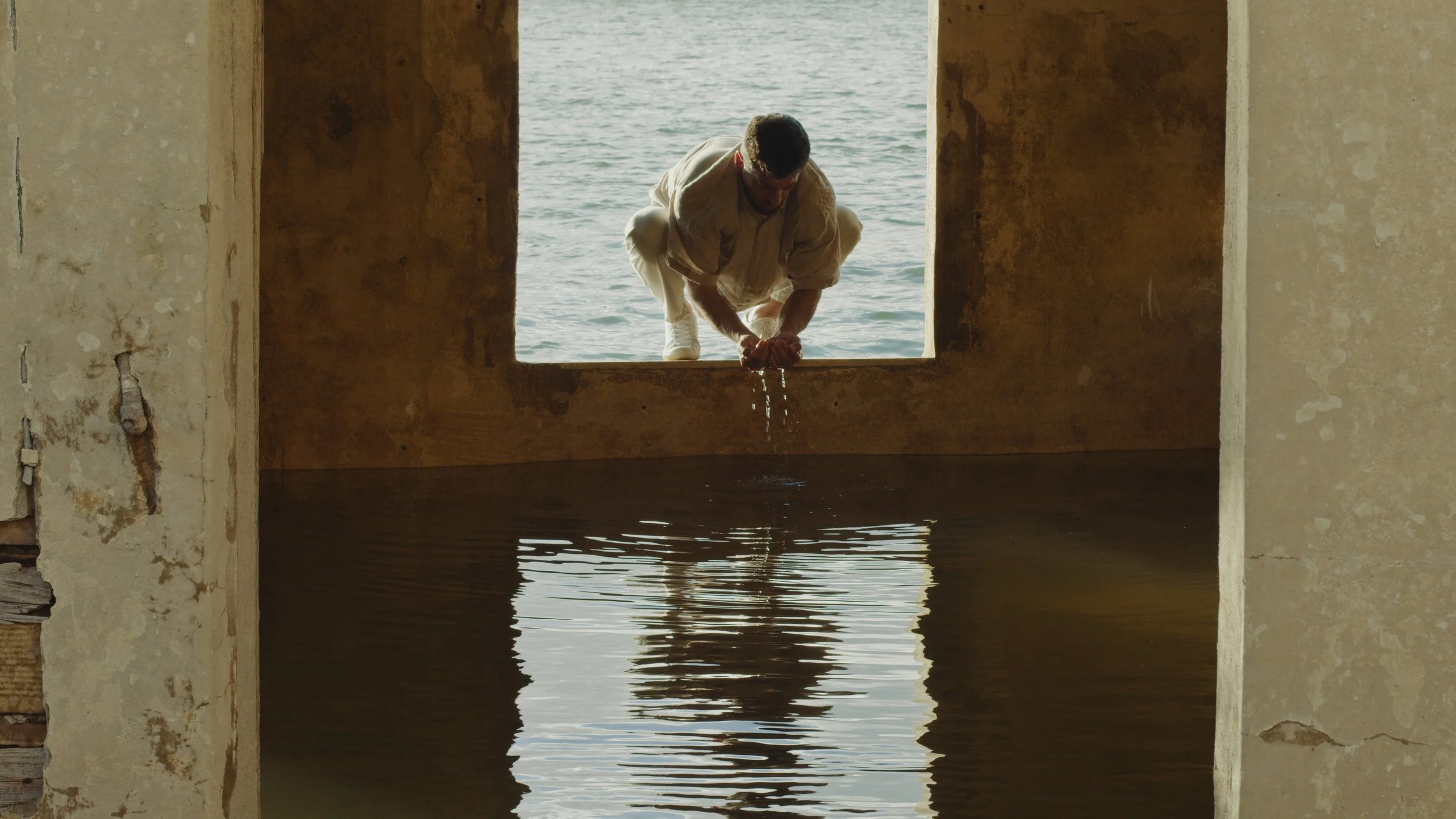
“I wanted the dancers to exist at the heart of this paradox, moving between the ancient and contemporary ruins of the island, searching for connection within places already marked by absence and history.”
Music and sound seem to operate almost as part of the environment itself. What conversations were you having with Venus Volcanism and In Atlas around tone, atmosphere, and emotional space?
I knew from the beginning that I didn’t want to use purely traditional Cretan music. I was looking for something that could carry the essence of tradition while still feeling contemporary — something rooted in heritage, yet made in the present.
When I first heard the music of Vénus Vocalism, I immediately felt it could exist naturally within the world of the film. Vénus blends traditional elements with electronic textures and ambient soundscapes, while also incorporating field recordings from nature — birds, wind, animal sounds. There’s something deeply organic and atmospheric about her music that felt like the perfect soundtrack for the film.
The lyrics of the song used in the first half of the film come from a form of Cretan music called Rizitika, which is usually performed in a very traditional manner. But Vénus reinterprets these elements through electronic soundscapes and natural field recordings, creating something that feels both ancient and contemporary at the same time.
As the edit developed, I realised I wanted the sound to evolve alongside the movement and emotional progression of the film — beginning in a restrained, almost meditative state, before gradually breaking into something more intense, rhythmic, and sharp. That tension felt very aligned with the movement direction itself. This led to the introduction of a more electronic and beat-driven sound for the second part of the film. In Atlas became involved in collaboration with Vénus, helping shape a sonic shift that carries the film into a more immediate, present-day energy.
Much of your work seems interested in the tension between movement and belonging; between leaving, returning, and searching for home. Do you see Ruins Within Ruins as part of that ongoing exploration, or did it open up something new for you creatively?
For many years, I resisted the idea of heritage because I felt disconnected from the folkloric imagery often associated with the island of Crete. It didn’t fully reflect my understanding of identity or belonging. Over time, that shifted, and I became more interested in approaching those roots through a different lens — one that acknowledges tradition without becoming fixed in nostalgia or representation.
My relationship with Crete is very personal, yet in many ways it extends beyond the island itself. Ruins Within Ruins marked a turning point in how I think about storytelling and identity — not as fixed ideas tied to a specific place, but as shifting questions that evolve through movement, landscape, and human experience.
Working with dancers for the first time also introduced a new cinematic language for me — one rooted in gesture, rhythm, and the body. It opened up a way of thinking where meaning is not only constructed through language or narrative, but through movement and the relationship between bodies and space. In that sense, the film was less about a fixed subject and more about exploring questions that were already present in my practice, but had not yet found a form. Rather than a conclusion, it felt like the beginning of an ongoing line of inquiry — an ongoing process of research. I’ve already finished filming a continuation of this exploration, focusing on different layers of folk culture, tradition, and myth, and how they continue to resonate — or shift and transform — in the present context.
directed, edited and produced by — LEFTERIS PARASYRIS
choreographer — DIMITRA DASKALAKI
dancers — MARINA CHRISTODOULAKI, DIMITRA DASKALAKI, SAKIS DIMOPOULOS, KOSTANTINOS THODORIS, NINA KRANIIDIOTI
cinematographer — YORGOS BOBOLAKIS & HARIS DOUKAKIS
colour grading — LYUBOMIR BALABANOV
drone — ARISTOTELIS DASKALAKIS
set photography — MANOLIS VARDAS
costumes — EVA PAGALOU
makeup artist — MIRTO ALEXAKI
production manager — VICKI CHRISTAKI
production assistant — MIKA PARASYRI
production service — IMEROS ART
music — VENUS VOLCANISM & IN ATLAS