An exploration of the everyday work of making space for what matters
Directed by Ahmad Ghanim
words by Isabella Bazoni
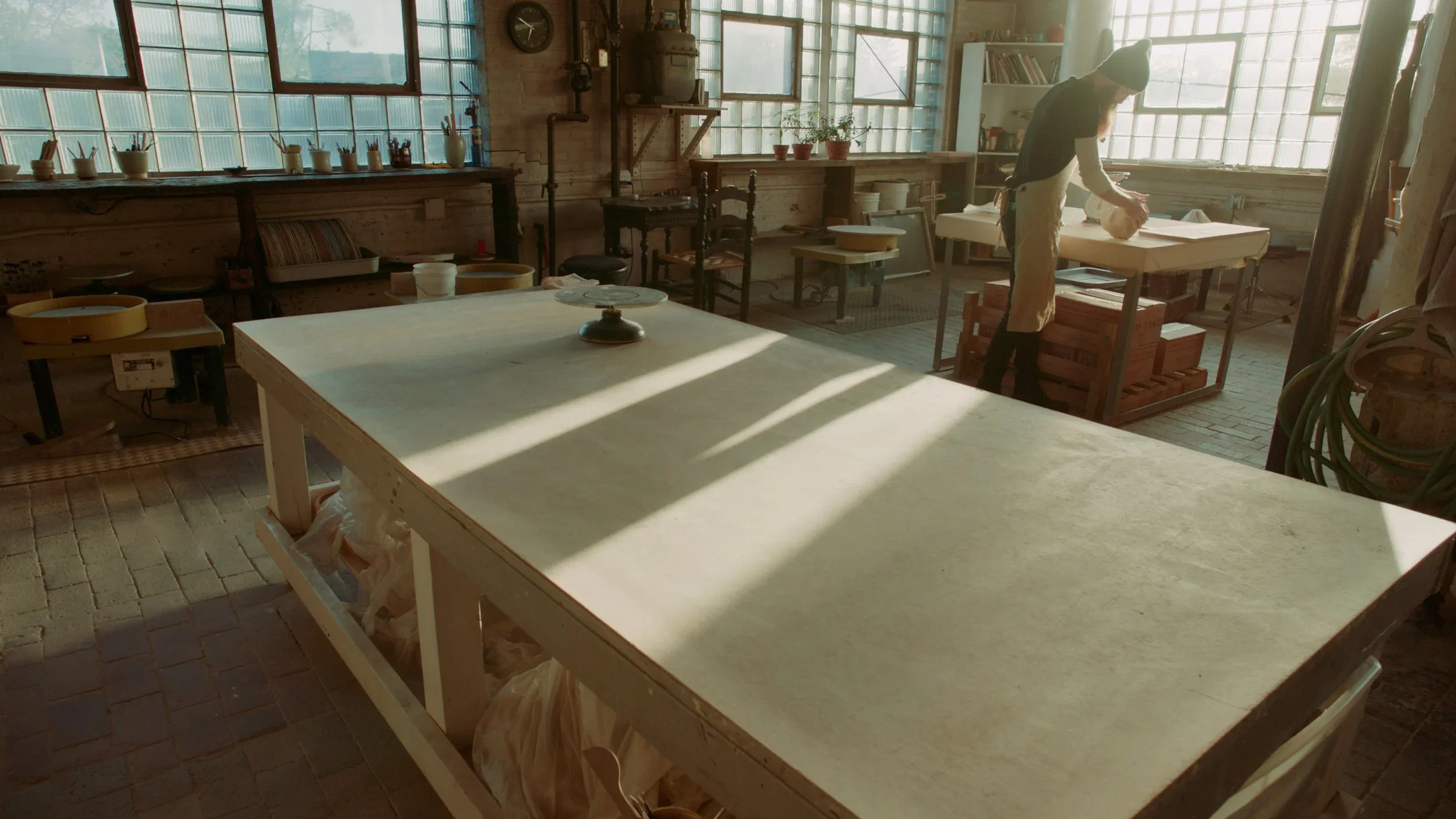
For Palestinian-American filmmaker Ahmad Ghanim, filmmaking begins with the emotional textures of everyday life. His documentary Taking Shape follows ceramicist and production sound mixer Nate McLaughlin, whose relationship with pottery becomes a way into broader questions of passion, personal agency and the connections that sustain us. Centred on the journey of ceramic vessels through the pottery studio, the film considers what it means to pursue something with intention, particularly when the freedom to follow one’s interests has not always felt within reach.
At its heart, Taking Shape is concerned with the relationship between art and community, and the willingness to move beyond familiar routines. Through McLaughlin’s reflections on creative practice, friendship and the effort required to remain present amid life’s competing demands, Ghanim approaches making as something that extends beyond the finished object. The film invites us to consider how opening ourselves to unfamiliar experiences can reshape our understanding of the world around us, and how the things we choose to make can bring us closer to one another.
The film follows the transformation of clay alongside Nate’s reflections on opening himself up to unfamiliar or uncomfortable experiences. What first drew you to his story, and when did you begin to see these two processes as connected?
Making this film taught me the importance of collaborating with great story partners. I’m grateful to each member of the crew for affording me this sandbox of materials to play with. To work with someone as vulnerable and giving as Nate is a dream.
What drew me to this project initially was my interest in Nate’s philosophy on life and how that was distilled into his artmaking. There was a passion and sensitivity in his way of talking and facial expressions. I remember seeing some of the same expressions at the pottery wheel in posts he would share online and thought that would be interesting to explore.
I was also drawn to Nate’s maturity as a person. I wondered about his journey. It’s hard to know if film has the potential to take off the ground. I realize now that there are a lot of things that need to line up and click amongst collaborators. The more I learn about the process, I see that it’s a miracle any film gets made. I certainly didn't know this is what we would make when I first started. I think it was really a desire to hang out with Nate more. Our friendship grew closer over the course of producing this. The spirit of the Taking Shape speaks to just that.
There’s something inherently physical and patient about ceramics. How did the process of watching Nate work with clay influence the way you approached the film visually and rhythmically?
The visual language was inspired by both Nate’s cadence in voice and the meditative process of ceramics itself. There were moments at the wheel where the body was physically challenged that me and Sam took note of. I often find that faces inspire me which is what draws me to portrait photography. Glimmers of moments that feel like a window into a deeper world. Paying attention to the rhythmic rising and falling tension of pottery was something I found to be interesting layered with dramatic moments of the film as well. It’s such a fun puzzle to try and tie story elements together in an honest way. It all stems from what the story partner is offering. That helps inform how we film a scene and ultimately the edit. It felt right to have most of our shots be locked off. I learned to not be so controlling about how things landed and to bounce off of what’s in space.
“The visual language was inspired by both Nate’s cadence in voice and the meditative process of ceramics itself.”
Nate talks about allowing passion to guide the choices he makes, while also acknowledging the effort involved in maintaining relationships and making space for the people around him. What interested you about exploring creativity alongside those more everyday forms of commitment?
I’ve always loved movies that use physical mediums as a vessel to explore deeper human themes. Whether that be tennis or drumming, some of my favorite filmmakers find a way to make something I’ve never done feel personal. Pursuing a career in film is way more difficult than I ever would have imagined. Questions begin to arise about how to balance life and hobbies with a career. Sometimes those lines are blurred together. I was curious about Nate’s thoughts on that in our initial recorded conversations. When I’m dealing with specific problems of life, it’s interesting how the brain singles out all there is around that issue which seeps into the art we make.
How do we maintain a spirit of experimentation and freedom with our art as we get older and the stakes rise with each project? I had this question on my mind during my conversions with Nate. I worry if this fear of making something that works gets in the way of starting anything. With each project something new is learned, but every film starts from ground zero there’s no way of predicting where you’ll end up.
What’s so fascinating about filmmaking is that for as much as you may try to predict variables of production, you can not control what you will be given on the day, the emotions of the cast and crew, the weather, the equipment. Your finger is always on the pulse of these elements everyday as the director. That’s what makes it so alluring to me. These relationships on set are intertwined with the medium itself. There’s no separating them just like a lot of other areas in our life.
At the heart of the film is this relationship between art and community, rather than the idea of creativity as an entirely individual pursuit. How did you want that sense of connection to come through without losing the intimacy of Nate’s personal story?
Finding a bridge between his personal life and the studio was a challenge. I still question whether or not it really works. But once I understood the main theme of the film, everything that fell outside of that needed to be cut. Anytime we see Nate working with clay, it’s tied back to the people in his life. Whether that be him talking about the faces he sees for the pieces at the start or imagining serving food on them to those he loves. Adding some depth to start in the opening sequence to ground what comes later was tricky to figure out. Cutting between shots at the park to the studio directly shows the idea of a childlike creative freedom it has for Nate.
Your background is in cinematography and lighting, and your work often explores the space between strength and vulnerability. How did you and cinematographer Sam Stephenson develop a visual language for Taking Shape that could hold both sides of Nate’s character?
Me and Sam spent a few days at the studio with our stills camera to observe Nate which proved to be extremely valuable. Paying attention to the beats of the process in the studio through stills sparked our imagination a shot list. Certain expressions and
body positions Nate had while creating a vessel to me signified that fluctuation between vulnerability and strength. I wanted to build a connection between the journey of ceramic vessels and people. The opening sequence shows Nate’s inquisitiveness and also that the film will be a glimpse into his life.
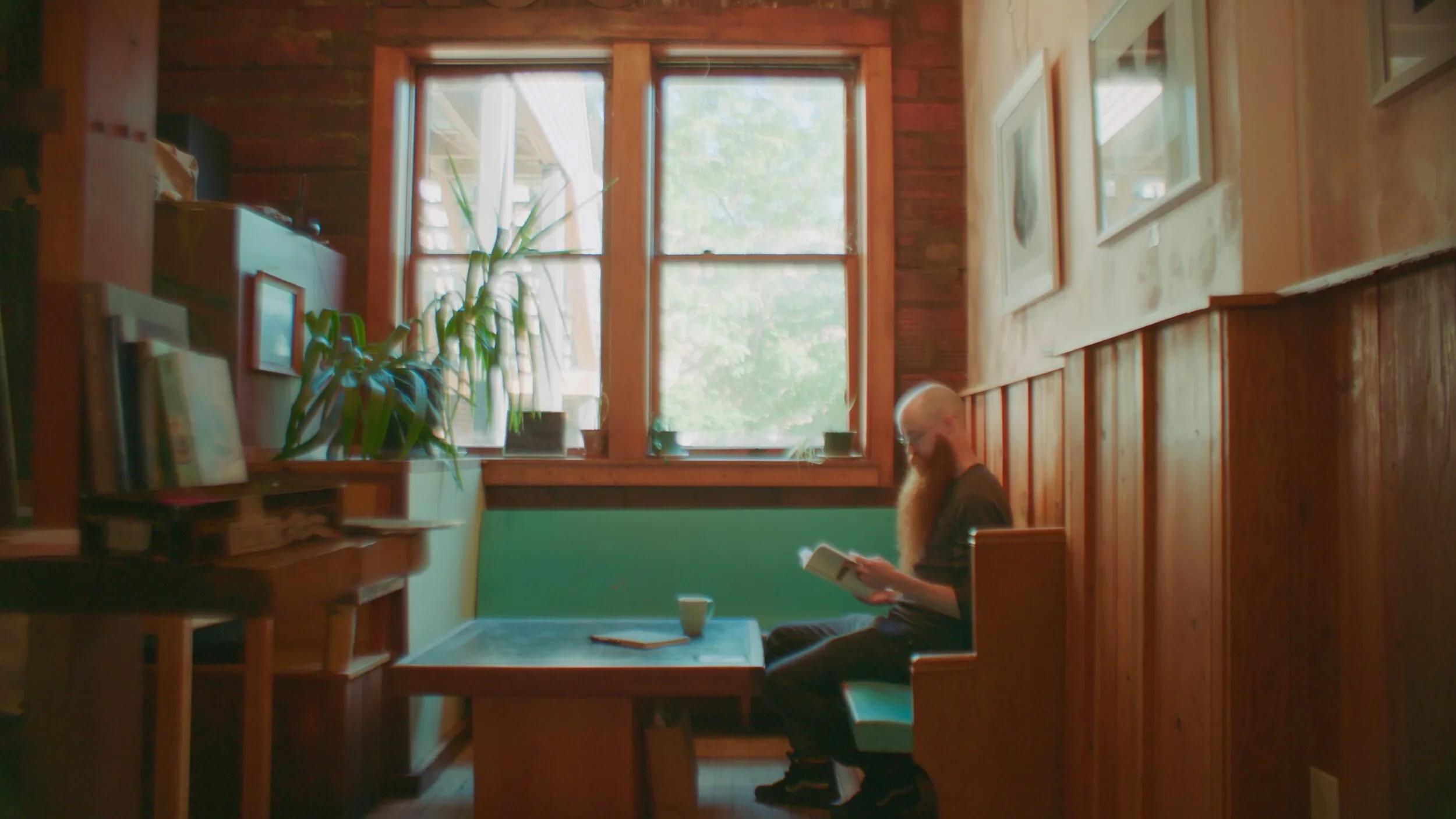
“Filmmaking asks that you be perceptive to what’s going on around you. I believe this practice serves as the foundation for what creates empathy”
You’ve described your own creative process as beginning with everyday interactions within your community. What makes you want to turn your camera towards the people around you, and what are you looking for in someone or something that makes you feel there’s a film there?
Built into the spirit of Taking Shape is having a mindful awareness of where people are coming from, how our surroundings shape the person we become, and what draws us to art is each other.
Filmmaking asks that you be perceptive to what’s going on around you. I believe this practice serves as the foundation for what creates empathy. At this stage in my process, it feels only right that the work I make is connected to who I’m around. It’s always a conversation and I’m trying to lessen the gap between myself and the person who chooses to be in front of the camera. In other words, I’m looking for myself in them.
The product ultimately speaks to the love I have for my story partners. Even at times when my relationship with the person I’m working with is a complicated one. I think the privilege of this medium is that it gives you a moment to understand the other even if it’s a hard thing to do at first. You can at least understand their position. That’s what excites me about all of this and I feel like I’m just getting started.
director — AHMAD GHANIM
featuring — NATE MCLAUGHLIN
cinematographer — SAM STEPHENSON
1st AC — MARIS WIRT
editor — AHMAD GHANIM
musical composition — JAKE WESTON
production sound mixer — NATE MCLAUGHLIN
set photographer — ABIEL REYES GARCIA
title cards — GRACE
pottery studio — BILLY RITTER
camera rental support — LIMINAL SPACE