HAPPY HOLY FAMILY
A surreal portrait of the violence that hides behind perfection
Directed by Lea Thurner
words by Isabella Bazoni
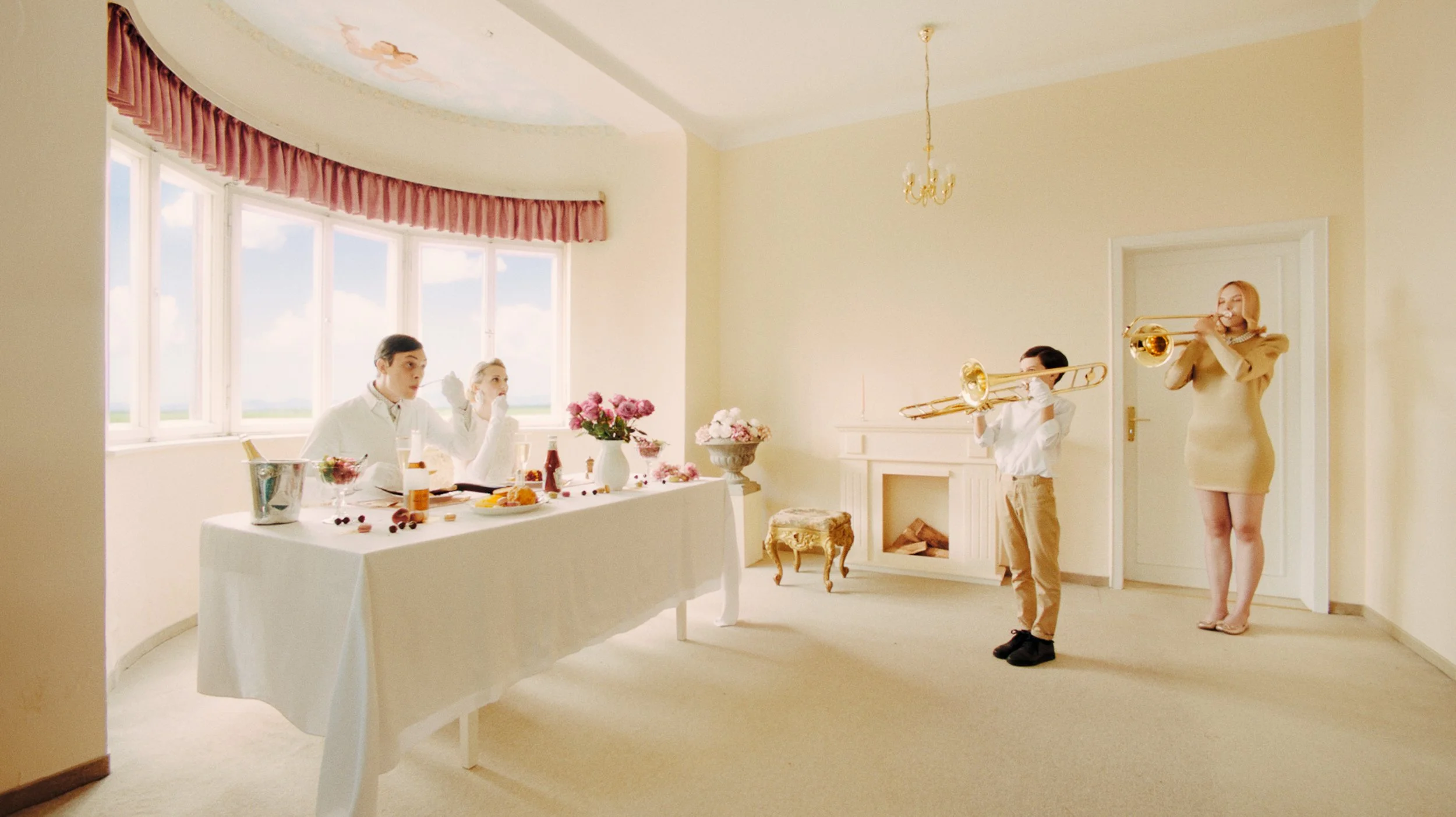
Director Lea Thurner takes the image of the perfect family and turns it into something sinister and unsettling. Drawing inspiration from René Magritte’s surrealism and the carefully maintained performance of domestic perfection, Happy Holy Family explores psychological abuse through a world where everything appears flawless, orderly, and controlled.
The result is a collision between suburban fantasy and psychological nightmare. Smiling faces, immaculate interiors, and choreographed family rituals slowly begin to reveal deep cracks beneath the surface, exposing the invisible forms of control and abuse that often remain hidden from outsiders — and sometimes even from those experiencing them. Rather than focusing on overt confrontation, Thurner is interested in the quieter mechanisms of emotional manipulation, allowing tension to build through repetition, restraint, and what remains unsaid.
Working with cinematographer Nico Schrenk, she creates a visual language that is as seductive as it is oppressive. Every frame feels meticulously composed, reinforcing the illusion of perfection while simultaneously trapping its characters within it. The result is a film that uses surrealism not as an escape from reality, but as a way of revealing the unsettling truths that often sit beneath its surface.
Happy Holy Family approaches emotional abuse in a way that feels strangely beautiful, surreal, and deeply uncomfortable all at once. What first pulled you toward approaching the subject through this kind of visual world rather than something more naturalistic?
I think life itself is profoundly uncomfortable. But that doesn’t mean it isn’t beautiful. It’s the classic relationship between light and shadow. What interested me was the question of how to make a film about emotional abuse without relying on the familiar images we already associate with violence. I mean, we all know what a sad woman looks like. We know what a stressed man looks like, or an anxious child. Those images are deeply ingrained in our visual memory. But emotional abuse is often much harder to see. It hides beneath the surface. So the challenge became: how can we make the audience not just observe it, but actually feel it? The surreal visual language emerged from that question. It allowed us to create an emotional reality rather than a purely realistic one
The film constantly plays with the gap between appearance and reality: this polished image of the “perfect family” slowly starting to fracture underneath the surface. There’s also something that feels reminiscent of The Truman Show and even the unsettling suburban artificiality of Soundgarden’s Black Hole Sun video. What were the kinds of constructed worlds you were inspired by, and how did they influence the way you approached the film visually from the beginning?
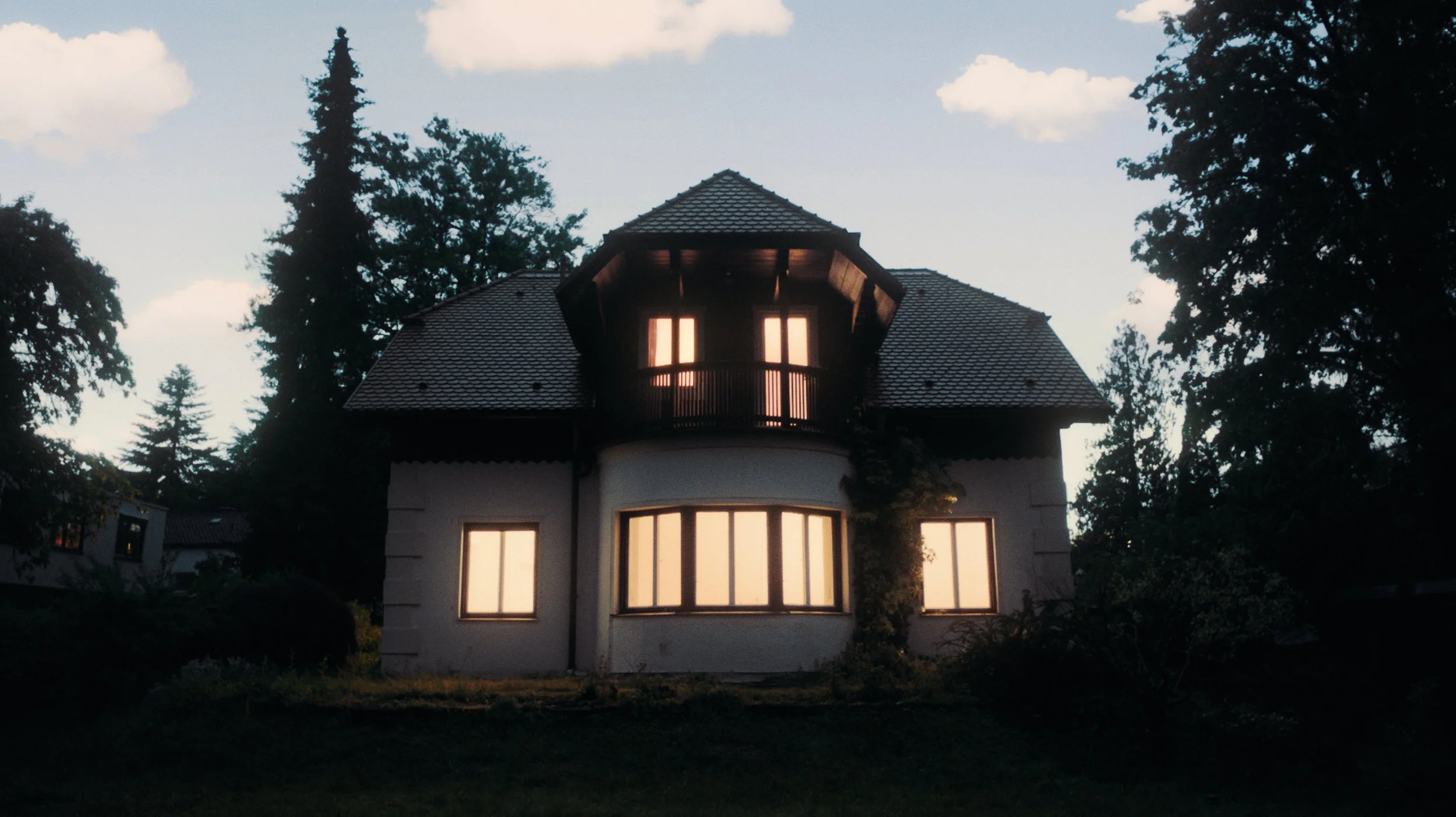
Thank you, great films !! But honestly, I try not to get too inspired by other films in the early stages of a project. Otherwise, I end up chasing someone else's vision instead of finding my own. For Happy Holy Family I was mostly looking at René Magritte's paintings and Miles Aldridge's photography. And I spent a lot of time reading about the experiences of people who had gone through emotional abuse. What was so crazy to me is that emotional abuse can feel deeply wrong, yet you still question your own perception. From the outside, everything seems perfectly fine, everything is supposedly "okay."But there's always something lingering beneath the surface, like a ghost that never quite leaves the room.
“What interested me was the question of how to make a film about emotional abuse without relying on the familiar images we already associate with violence.”
You referenced René Magritte and there’s definitely something Magritte-like in the way ordinary domestic spaces start to feel psychologically distorted in the film. Were there particular works, images, or ideas that stayed with you while developing the piece?
I remember seeing an exhibition of Magritte's work when I was about fifteen. I stood in front of those paintings completely fascinated how something could feel so unsettling while looking so calm and precise at the same time (maybe that's also a very teenage feeling). What I love about Magritte is the way he places two realities side by side: the outer world and the inner world. They seem perfectly balanced, yet something feels off. That tension is incredibly powerful. We tried to explore something similar in Happy Holy Family. We quoted a few of his paintings, including L'Empire des lumières, La Reproduction interdite and Le Fils de l'homme.
So much of the tension comes from restraint — from what characters don’t say, or what remains hidden beneath gestures and routines. How did you work with performance and blocking to create that feeling of invisible violence?
Usually, I love it when actors meet before a shoot and spend time together. But for this film, we intentionally avoided that. We were interested in a very specific tension, people sharing the same space without truly connecting. So instead of encouraging familiarity, we tried to preserve a certain distance. Performance-wise, it was all about finding a balance between acting and holding back. We talked a lot about what not to show. Sometimes the most important thing wasn't the emotion itself, but the effort to hide it. So the camera could slowly discover those cracks underneath the surface. To be honest, it must have looked super strange from the outside. A group of actors carefully avoiding the obvious emotional choices while hitting very precise marks. But that awkwardness was actually part of the process.
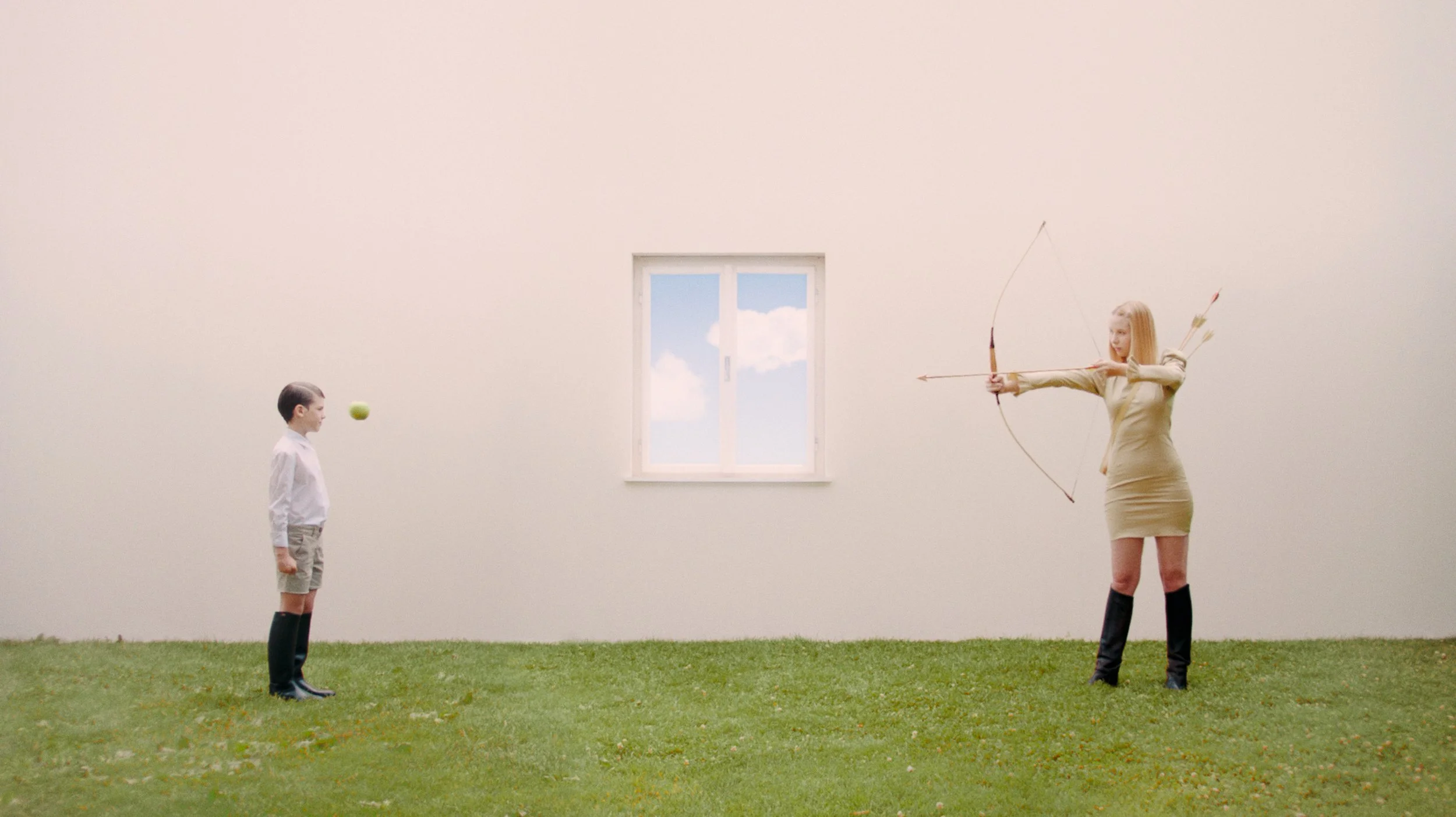
“From the outside, everything seems perfectly fine, everything is supposedly ‘okay.’ But there’s always something lingering beneath the surface, like a ghost that never quite leaves the room.”
The compositions feel incredibly controlled, almost trapping the characters inside the frame. What conversations were you having with your cinematographer, Nico Schrenk, around framing, symmetry, colour, and visual repetition?
Nico is great with available light and handcamera, so when we first met to speak about the project he asked my why I want to shoot this film with him. For me, it was never about a specific visual style. It was about the way he sees people. Nico has a deep empathy for his characters, and even when an image becomes strange or highly stylized, it still feels emotionally truthful. For this film, we planned every frame in advance. I normally work more intuitively during production. With Happy Holy Family it was the opposite: the intuition happened while writing and developing the film, and once we were on set, the process became extremely precise.
The Mirror Shot is probably a good example: We shot it in 3 shots, measured the perspective for the reflection and offset the camera accordingly. As we couldn’t afford motion control we had a laser and a metronome and timed that with light cues on an LED strip next to the dolly tracks to maintain the exact speed and timing. First we shot just the reflection in the mirror, then we shot her with the mirror being a greenscreen, then we shot her in front of a greenscreen with the dolly offset so it would match the reflection perspectively. We wanted the images to feel almost too bright and spotless. Combined with the rigid framing, that created an underlying sense of unease. The more controlled the frame became, the more trapped the characters felt inside it.
There’s a fine line in the film between absurdity and emotional truth. How did you navigate balancing those more stylised or surreal elements without losing the human reality underneath them?
To be honest it just came naturally because of the topic. It always was important for us to not just “use” the topic and to really take it seriously. And of course there is this great cast who managed to stay playful and light even though the situations itself weren’t It was some kind of experiment for them as well, so we laughed and tried out a lot. And sound design. I LOVE sound design, it is such a great tool to create and lead emotions but in a very subtle, nearly unconscious way.
Even though the film deals with psychological abuse, it never feels explanatory or didactic. Was it important for you to leave space for ambiguity and interpretation rather than fully defining what we’re seeing?
YES!! Always always always. We live in a society where pretty much everything is meant to be understood and already packaged in a cute little insta caption or ai prompt. I think it is important, and so much fun, to just not know everything and use your brain.
director — LEA THURNER
director of photography — NICO SCHRENK
producers — LISA PURTSCHER, JULIUS WIELER
editor — FRAUKE TIETJEN
vfx supervisor & visual artist — TOM TOLLE
matte painting artist — PHILIPP STEIN
sound design — JULIAN BERG
music — HANNES BIEBER
set design — SOPHIE ROHM
costume design — LISA HEINISCH
hair & makeup — MARIE ZIEMES
1st AC — NICOLAI SCHETTEN, MALIN MÄRTENS
2nd AC — CHRIS GRUBER
claim — PIRKO NEUMANN
motion design — LENNARD MAKOSCH
cast — SAMUELE MACI, ANNALEN FRAGE, JULIA KEMP, BENJAMIN SCHAUPP