IN THE HEART OF THE FLOWER CITADEL
Fashion as expanded cinema, where movement, light, and architecture converge
Directed by Adam Muscat
words by Isabella Bazoni
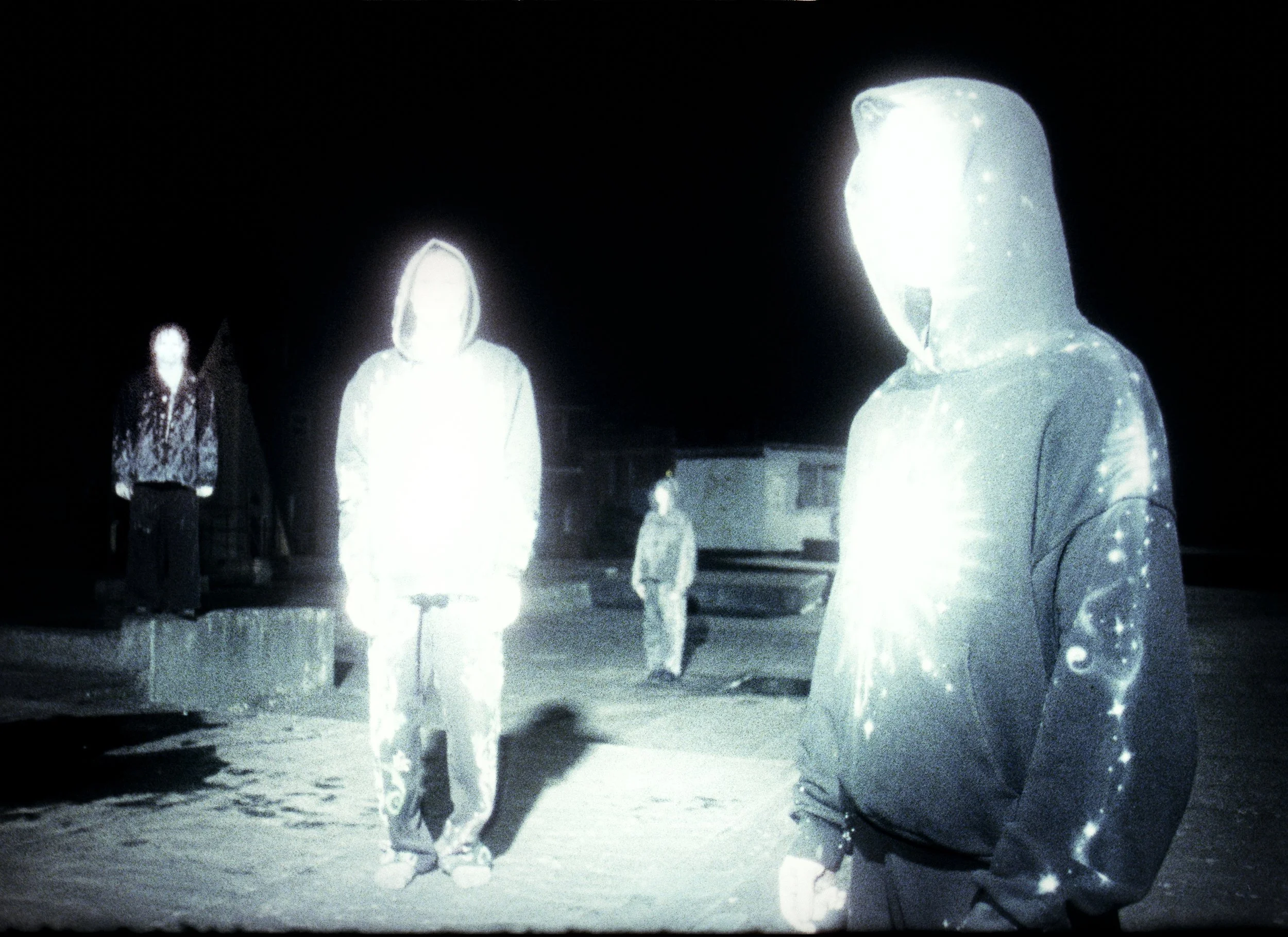
In In the Heart of the Flower Citadel, artist-designer nil00 and filmmaker Adam Muscat dissolve the boundaries between fashion, cinema, and installation. Set within a fractured, celestial cityscape, anonymous figures leap and tumble through luminous structures, their movements carrying the viewer through moments of awe and unease. Wordless and immersive, the film unfolds as a study of light and darkness, embodiment and transcendence.
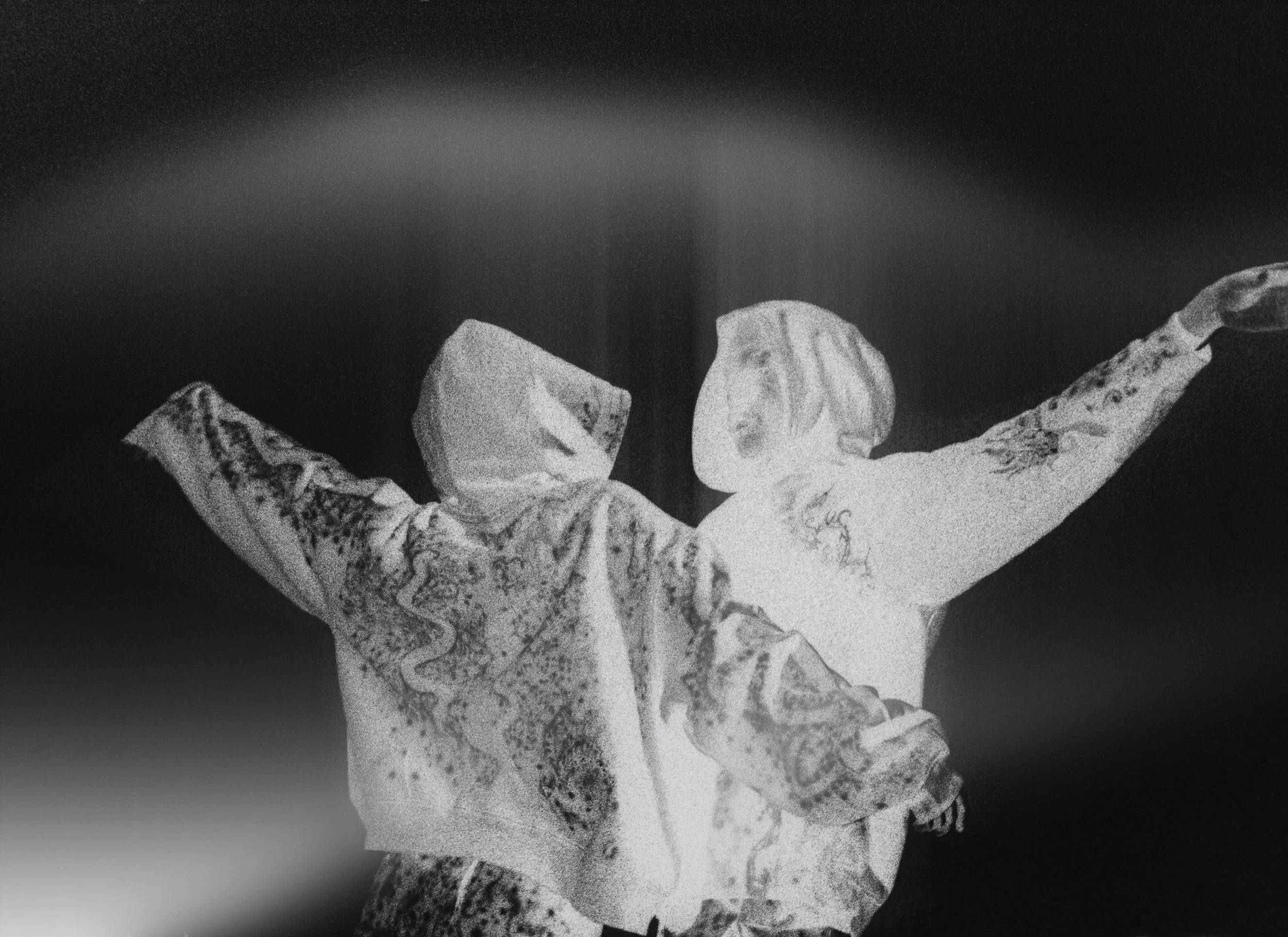
Developed as both a fashion film and a gallery installation, the project positions clothing as a narrative device. Nil00’s airbrushed tracksuits, rendered as abstract, romantic cityscapes, function as wearable canvases that blur the line between garment and environment. Muscat’s painterly visual language complements this approach, treating the screen as a spatial surface where movement, architecture, and light interact. Together, they propose fashion as a form of expanded cinema: an experiential encounter that resists the rapid consumption of digital imagery and instead invites viewers to inhabit its imagined world.
Muscat’s background across architecture, fine art, and fashion film informs the project’s sculptural sensibility. After studying architecture at Central Saint Martins, he moved into visual storytelling, collaborating with brands including Sergio Tacchini and working in-house at Fendi before completing an MA in Fine Art in 2022. His practice now spans film, installation, sound, and painting, often exploring how cinematic language can extend into physical space. In In the Heart of the Flower Citadel, this multidisciplinary perspective finds a natural expression, where fashion, performance, and environment merge into a single immersive experience.
In the Heart of the Flower Citadel dissolves the boundaries between cinema, clothing, and space. When did you realise the project needed to exist beyond a traditional fashion film format?
Adam Muscat: From the first conversation we had about the project, it was about our practices intertwining. My goal was to integrate my cross-disciplinary art practice which involves installation, sound and painting into film, backed by the technical understanding and network I have built over the past 3 years working full-time as a film editor. I felt like this approach also reflected nil00’s brand and practice - she’s not a traditional fashion designer as such, but uses garments as the canvas for her intricate and ethereal airbrushed artworks. I thought immediately that this interplay of fashion, art and film was an interesting angle and would open up a space whereby we could blur the boundaries of filmmaking, going beyond the rigid and ultimately commercial precepts of fashion film.
Nil00: I never started with the ambition to create a traditional fashion brand because I’ve never been in thrall of the fashion industry on a personal level, it doesn’t interest me. I appreciate the work of designers and watching runways but just never got into the whole prestige of it all. That unburdens me of any ambitions of ascending within a traditional paradigm, I’m not even really totally aware of what the traditional paradigm is. I was never gonna be there looking over his shoulder saying “we need more product in the shot”. So I think that laid the groundwork for a really fun and personal collaboration. It came from us showing each other our work, sat on a bench outside the club and feeling a natural synergy. I wanted Adam to express himself fully because I could tell that whatever came from him would speak to my work without forcing it. As an editor he’s an experienced professional embedded in an industry but this came from our connection as artists, he showed me his paintings and installation work and it just made sense, and I was excited to see what he would do.
“I wanted to blur the boundaries of filmmaking, going beyond the rigid and ultimately commercial precepts of fashion film.”
The film unfolds as a wordless study of light, darkness, and transcendence. How did you construct an emotional narrative without dialogue or explicit storytelling?
AM: I have always been attracted to non-linguistic forms of emotional expression, how the entanglement of image and sound creates meaning and feeling. Working as an editor, I am constantly in conversation with these two elements, grappling with how a film might feel or come across through its tonal presence. The challenge of creating a 5ish minute film that is able to capture an audience’s attention without words interested me, it felt like the natural progression of my visual practice. My installation work consists of large scale paintings in a spatial context, also incorporating elements of light and sound. The process of creating a space which allows people to walk in, experience multiple mediums and leave feeling something that hasn't been directly said or told to them, is the exact essence of what I wanted to capture in this film.
Moreover, the silence within the film gives way to musical compositions and creates a different kind of intimacy for me. Where music is often enjoyed without explanation, curatorial statement, or socio-historical context, art experiences often rely on framing and exposition to make their point known. I like my work to be experienced like music.
“Clothing is always narrating something, some idea of who the person is in the world.”
The anonymous figures move with ritualistic intensity through a fractured cityscape. Who are they to you: symbols, avatars, provocateurs?
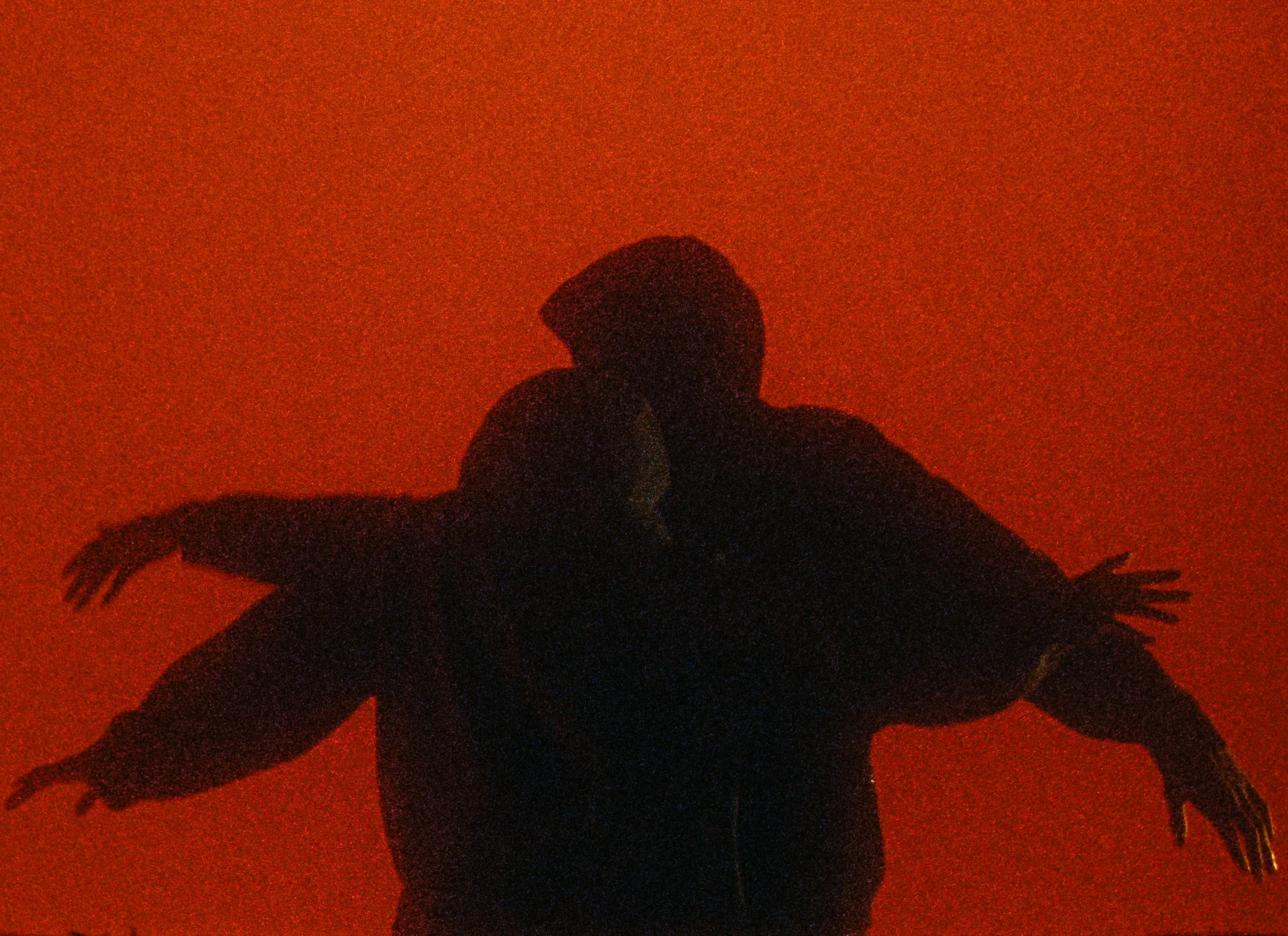
AM: I think they are a mix of human and non-human entities. There’s enough information and detail in there for the viewer to connect and understand the characters, but at the same time I wanted to distort, fracture and disrupt the figures. The conventions of narrative storytelling tend to place characters within a social context, but I wanted to gesture beyond the veil as well. Especially in the second half of the film, there is an intentional abstraction to convey the spiritual aspect of these beings, using movement, colour and distortion to encapsulate an enduring beauty that extends beyond language.
N: When we first spoke about the film I was telling Adam how my airbrushed designs are for me an expression of complex spiritual revelations that I have not been able to decipher or put into words. I think this shared interest in mysticism and the unutterable is where our work intersects - Adam’s paintings and installations also contemplate the mystery, and question whether its darkness or light behind the great curtain. The trickster-like figures in the film hold those questions within their refusal to disclose.
Nil00, your airbrushed tracksuits function as both garment and landscape in the film. At what point did clothing shift from costume to narrative and spatial device?
N: Painting on clothing for me came after getting back into drawing after years working as a writer, videographer, curator, digital artist - all really cerebral endeavours. And it was a natural process of inspiration that led to it - I was sad, I was drawing dragons, I saw an image in my mind of my clothes covered in them, and I knew that was the next direction. It was a lifestyle thing as well, I saw an opportunity to support myself and my music doing something joyful and stop half-cynically renting out my cognitive abilities to industries I didn’t really believe in. I didn’t wanna become an Instagram tattoo artist so I thought yeah, airbrushing.
Clothing is always narrating something, some idea of who the person is in the world. I’d been kind of checked out of that game for a few years since lockdown, got out of the habit of pulling looks and started dressing like Adam Sandler all the time. Ridiculousness and disruptiveness have increasingly become the impetus for my sartorial gestures. The older I get the less I care about how I’m perceived, I’m really out here to have fun and maybe to poke fun. So I think painting on clothes also allowed me to get excited about dressing again, I guess it’s an outsider artist type point of view on fashion that comes from who I am. I feel immense distance from the common practice of using clothes to establish belonging or signal sophistication, I feel like we’re all playing dress-up and it’s funny, and it’s even funnier because everyone takes it seriously. It makes me laugh but also makes me feel worthy and rooted in my values when my clothes are insane, because deep down I don’t want to belong to this world of commerce at all. My work has monetary value because I need to survive but I’d rather give it all away, my true desire is to create things that people touch and use every day and are so pointlessly beautiful they can’t help to remember that life was meant to be fun.
It’s not about doing something revolutionary, I’m under no illusions about the material short-term impact of art. I’m just doubling down on the ridiculousness of it all and expressing the invisible sparkly world of my dreams for a better world, in a manner that I can live with and that I’m capable of.
“I like my work to be experienced like music.”
Adam, your background in architecture and fine art is evident in the sculptural quality of the film. How does spatial thinking shape the way you compose and edit moving image?
AM: When you study architecture, you learn that space is never neutral, it’s defined by subtle principles felt in the body. I try to approach cinema through this same sculptural lens, treating time-based media as a dimensional rather than linear storyline. To me, sound and image are mutually constitutive mediums that carve out the work's anatomy. Using pulses, visual effects, and flash cuts to create atmosphere allows the viewer to enter the work, rather than embarking on a story to follow in sequence.
This spatial thinking is deeply entwined with my background in abstract painting, where I allow a certain level of chaos and unpredictability into the process before slowly refining and honing in on the form. By allowing the material to misbehave in the same way, and pushing images beyond realism in the edit, the film becomes something inhabitable and dynamic. And ultimately, I trust the transformation that happens in post-production to reveal textures and emotional trajectories that weren’t visible during filming, allowing the work to stay alive through that tension between control and chance.
There’s a tension between transcendence and physical embodiment, spiritual revelation and pounding movement. How did you approach holding those opposing forces in balance?
N: For me, upcycling casual garments is about that tension, I love the contrast of the most everyday, comfy item of clothing also being your most ostentatious, intricately adorned possession. I like that it can add a flavour of specialness to like, going the shop. And if it’s something you are gonna wear every day you’re probably gonna ruin it and get holes in it. Like using a gorgeous painting as a doormat or something, it’s funny to me and sort of zen, an ode to impermanence. Kind of flipping the bird at that anally retentive aspect to the arts, fearfully handling these objects with gloves and tissue paper. As if we could hold onto anything, as if we’re not just passengers on the crest of a crashing wave, destined to be forgotten.
Also the process of my work with garments really involves me personally in the tension between transcendence and mundanity. The feeling behind it is so euphoric and otherworldly, but on a day to day a lot of it is the challenge of grounding that in the density of reality. It’s dealing with postal systems, it’s emailing customers, it’s posting on social media and all that kind of thing. I respect that the human experience contains so much admin; it’s so boring, but I like the challenge of maintaining a state of motion and presence amidst that slog.
The project resists the speed and disposability of digital fashion imagery. Was slowness or duration a conscious act of resistance?
AM: I think so, yes, not only in the way we structured the film, but also in the way we created it. From our first conversation to the release of the film we spent two years working on it. This involved moments of breaking and then revisiting as we worked on other projects, and also regrouping and changing elements over time. The luxury of time in this case allowed us to explore multiple paths and approaches. Working with a wide range of talented people also allowed us to end up with a piece of work that embodies this journey. Time allowed us and the team to develop their own practices as we went along. I truly think that if we had rushed the film and released it two summers ago, immediately after we shot it, the quality of the film would not be the same, and we wouldn’t be releasing it from the positions we are in now, both creatively and professionally.
This is also reflected in the actual length of the film. We didn't want to create a commercial fashion film that would only be viewed online. We wanted to create something that could be experienced in space, something that captures the essence and joy of entering a gallery and immersing yourself into a world.
N: The film project came at a transitional time for me and my business. I was totally re-evaluating my purpose as an artist and how much of my integrity was being compromised by a fear-based, hectic rhythm of life, set by the algorithm.
I hit a point of burnout and disillusionment with the world that just made me surrender to the pace of creativity as it wanted to happen - whatever vestiges of my success-pilled upbringing remained was burned away in the light of hard truth. So it was a conscious act of resistance to not rush it, and not give up on it just because it was taking a while, to trust that the world was just taking its time with us. I think we both went through a process of frustration and then acceptance during that time and it felt quite magical how the film coincidentally came out exactly 2 years after we first spoke about it. Like confirmation that our timelines and deadlines weren’t real, but the world’s were, and its wisdom was more perfect than ours.
That’s been healing for me in a way, I feel a greater sense of coherence in what I do because I am trusting the natural forces that made me to also co-create my work. It’s easier to let go of my fears when they come up; the urgency to complete work and have it be validated so I can feel a sense of purpose. I do not know what the purpose of my creative efforts really is anymore but I don’t ask that question either, I am just free knowing it isn’t to make a deadline or an altar to myself. If there is any use for my work in the world in the long term that is not up to me, and I don’t need to know it. I just need to be a vessel.
And there’s something about it coming out 2 years later on the dot - divine timing lol
designer — NIL00
director — ADAM MUSCAT
director of photography — DAJIANA HUANG
assistant director — JOHANNES AGBOIFO
movement director — ETHAN JACOBS
production — STUDIO PRIVATE
b-cam — ZMARAK
gaffer — STEPHEN ALLWRIGHT
sparks — MARC MALILAY, BELLE PALMANO, ROMY ROULIN
clapper loader — AIDAN SCHRAMM
focus puller — RAN YOU
on-set sound — CAJM
casting — SEEKERS
styling — NIL00, GINA CORRIERI
cast — FOLU ODIMAYO, ALEK WALENT, SONNY MIHAJLOVIC, MOSES WARD, ISAAC GLENISTER
editor — ADAM MUSCAT
sound — THOMAS HARRINGTON-RAWLE
vfx — GABRIEL ROLIM
cgi — SARAH LOU-MAAREK
grade — NATHANIEL SKEELS
film processing — DIGITAL ORCHARD
equipment rental — FOCUS CANNING, ONE STOP FILMS