A portrait of basketball in motion, finding poetry in the physicality, rhythm and unpredictability of the game
Directed by Mattias Evangelista
words by Isabella Bazoni
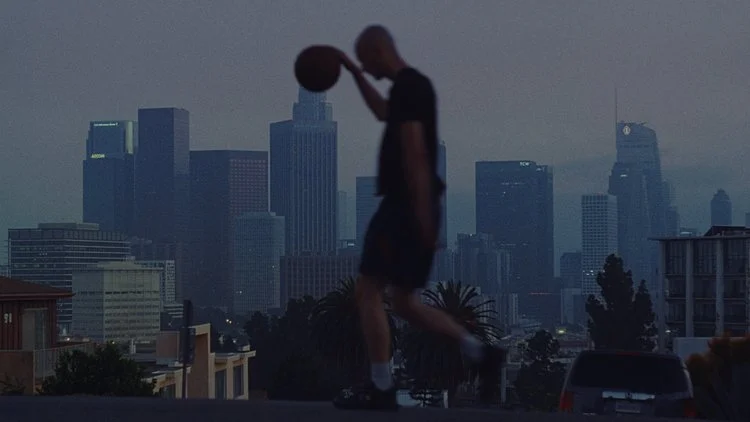
For filmmaker Mattias Evangelista, whose career began in the action sports world of the Pacific Northwest, movement has long been a starting point for cinematic storytelling. In Accustomed Matrix, a short commercial film for Wilson, the director turns his attention to basketball, exploring the beauty of the game through its physical gestures, rhythms and moments of imperfection. Filmed in Los Angeles on Kodak 35mm, the project brings Evangelista’s documentary sensibilities into a commercial context, prioritising the experience of playing over the spectacle of athletic achievement.
Working alongside cinematographer Christian Klein and Steadicam operator David Lanes, Evangelista approaches the movement of the camera as an extension of the athletes themselves, allowing the game to unfold naturally rather than constructing a conventional montage of sporting highlights. Accompanied by Ray Fleming’s poem One on One Basketball and the music of Kaitlyn Aurelia Smith, the film finds its expressive qualities in the space between athleticism and everyday experience. Every movement, missed shot and moment of anticipation becomes part of a cinematic study of the game itself.
Accustomed Matrix is described simply as “nothing to do with physiology or mysticism. Only basketball,” but the film feels much more abstract than a straightforward sports piece. What was the starting point for the project, and what did you want to explore through basketball beyond the sport itself?
This is a great point and something I never thought about. After reading your question it makes me think the logline should have been flipped to “this film has everything to do with physiology and mysticism.” With all of my projects I’m always interested in capturing the human experience and looking for moments of transcendence. With this project I wanted to seek moments of beauty and relatability through our athletes and the game itself.
There’s a strong sense of rhythm and physicality throughout the film, with the players’ movements becoming almost choreographic. How did you approach translating the pace, repetition and precision of basketball into the visual language of the film?
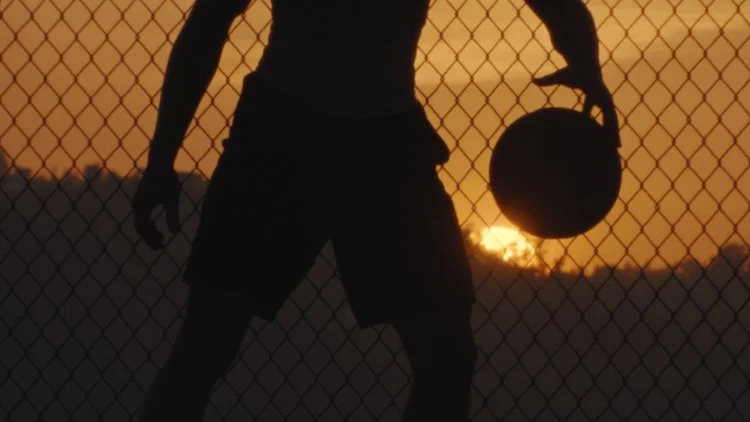
I was thinking about rhythm throughout the entire process of making this film. The guiding principle was to be searching for the poetry of the game. We achieved this through letting go and structuring scenes where we could watch the game unfold in real time. In a sense we wanted to work around the court and players instead of having them go through over-rehearsed scenes. Shooting primarily on Steadicam added a lot to the feeling of choreography, rhythm, and poetry. David Lanes was our incredible Steadi-Op and we always had moments where we would let David “play jazz” and feel out his camera movement in harmony with the players.
“Ultimately filmmaking - this shot, this moment, is not about me. It’s about something bigger and we’re just doing our best to capture that at this specific moment in time.”
Your background is rooted in action sports, where the camera often has to respond to movement as it happens. How has that experience shaped the way you approach filming physical performance, and did Accustomed Matrix push you towards a different way of working?
I think Accustomed Matrix is directly tied to my background in action sports and is an evolution of that style. The main way action sports has shaped my style is by feeling a connection to nature and trying to showcase that in all the work I do. The action sports environment also teaches you to let go. When you’re working with an athlete in the mountains you only have so much control over the moment and the shot. You have to be confident in your instincts and you have to let go. Ultimately filmmaking - this shot, this moment, is not about me. It’s about something bigger and we’re just doing our best to capture that at this specific moment in time. At this point, I’m trying to build a body of work that feels like me. I know what I’m interested in and I’m motivated to continue to explore those interests and sensibilities.
The film feels highly constructed, but there’s also a real sense of spontaneity and physical risk in the movement. How much of what we see was planned or choreographed, and how much came from allowing the players to respond naturally in the moment?
A core goal of this film was to show basketball actually being played. In so many basketball spots you see players randomly dribbling the ball or dunking, these explosive moments, but you don’t actually see the game being played in a real way. With this project we want to craft moments, scenes, and shots that let the game play out authentically. A missed shot was just as valuable as a make. This was a process of not being scared, especially when running longer takes on Steadicam. It’s such a natural instinct to cut or over direct if players miss a shot or a dribble. But, we leaned into that. We took a breath, simplified our camera movements, and watched the game unfold. The results are images that feel real and relatable to the audience. So few people can do an explosive dunk, but almost everyone can relate to the feeling of missing a shot during a pickup game and there’s beauty in that.
You worked closely with cinematographer Christian Klein and a wider creative team to build the film’s visual world. What were the key conversations around camera movement, framing, lighting and pace that helped define how the basketball would be seen?
For me everything is built around finding moments of beauty, especially in the in-between moments. No moment was too small to capture. This ethos is shared by Christian so it’s very easy for us to be on the same page and be chasing the same goal. Christian and I decided early on that we wanted to shoot 35mm and this innately creates a more controlled and disciplined workflow. We shot-listed a version of almost every shot you see in the film, so it was very planned from the beginning. Having this backbone also allowed us to relax and improvise as needed on the day. Vik Grossling was our great 2nd Unit DP operating our slow-motion camera. Christian and I both have enormous trust in Vik and that allowed us to work side by side effortlessly. Vik’s slow-motion captures added so much to this finished piece. On a technical level, all of my framing discussion and approach always start with depth of field. Shooting a deep stop and composing in depth is crucial for building cinematic images that resonate with the audience.
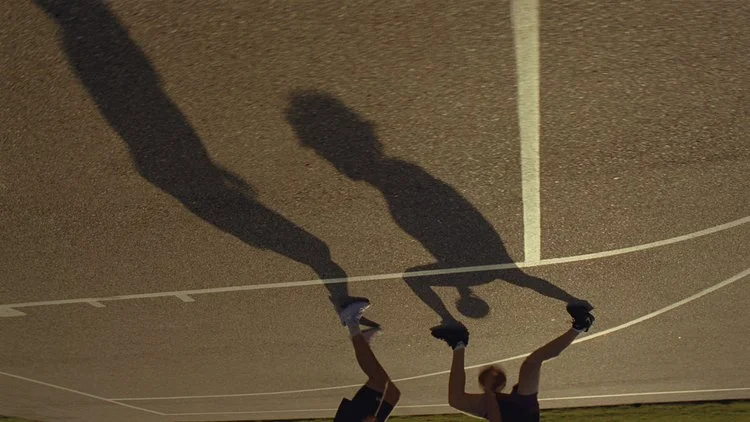
“So few people can do an explosive dunk, but almost everyone can relate to the feeling of missing a shot during a pickup game and there’s beauty in that.”
As both a director and editor, you’re involved in shaping the rhythm of a piece from both sides of the process. How did editing influence the way you shot Accustomed Matrix, and were there particular moments or transitions you were building towards while filming?
Initially, we intended for this spot to be a shorter, more commercial, 60s or 90s piece. But, as it turns out, I really don’t like spots like that and I think it’s unfortunate that they are such a cornerstone of the commercial industry. In many ways this film was a push-back against those hypey, over-edited pieces. In the edit I quickly realized that even though there was no dialogue, there was a story here. I was feeling that even before adding the voiceover. Also, as I sat with our scenes the poetry, and rhythm was shining and those images deserved proper screen time. I wouldn’t say there was a particular moment we were building to, rather a feeling that the whole piece should convey and I believe we achieved that.
director — MATTIAS EVANGELISTA
executive producers — TRUST & SARAH BRANNAN
producer — AUSTIN SWAIN
director of photography — CHRISTIAN KLEIN
1st AC — EMMA FIRULLI
2nd AC — RICKY JHOU & NATALIE IZQUIERDO
steadicam operator — DAVID LANES
2nd unit DP — VIK GROSSLING
still photography — MEGHAN ORETSKY
post-production — HOLOCENE
editors — MATTIAS EVANGELISTA & CAL LAIRD
colourist — DAN EDWARDS / UMAMI COLOR
colour producer — LUKE BUTLER
sound design & mix — LEWIS THOMPSON
voiceover — AYREE CHENISE
equipment rental — RARE BREEDS WEST
camera rental — ARTHUR TO
film processing & scanning — FOTOKEM
music — DYING IS A NORMAL PART OF LIFE BY KAITLYN AURELIA SMITH
poem — ONE ON ONE BASKETBALL BY RAY FLEMING
featuring — MORGAN “MO” JACKSON, MIZUKI “MIMI” HIGASHIJIMA, YAMATO NGUESSAN, BROOKS THODEN, BLAKE BALLARD, SHAOYAN PANG, JAI JACKSON, MONGA MOKWALA, MATIA DIVAC, LUKA DIVAC, LYANNA LIN & ZACHARY TSAI