A five-part dark comedy series made with Tinygiant and Rocket Surgery for Lex International
Directed by Trevor McMahan
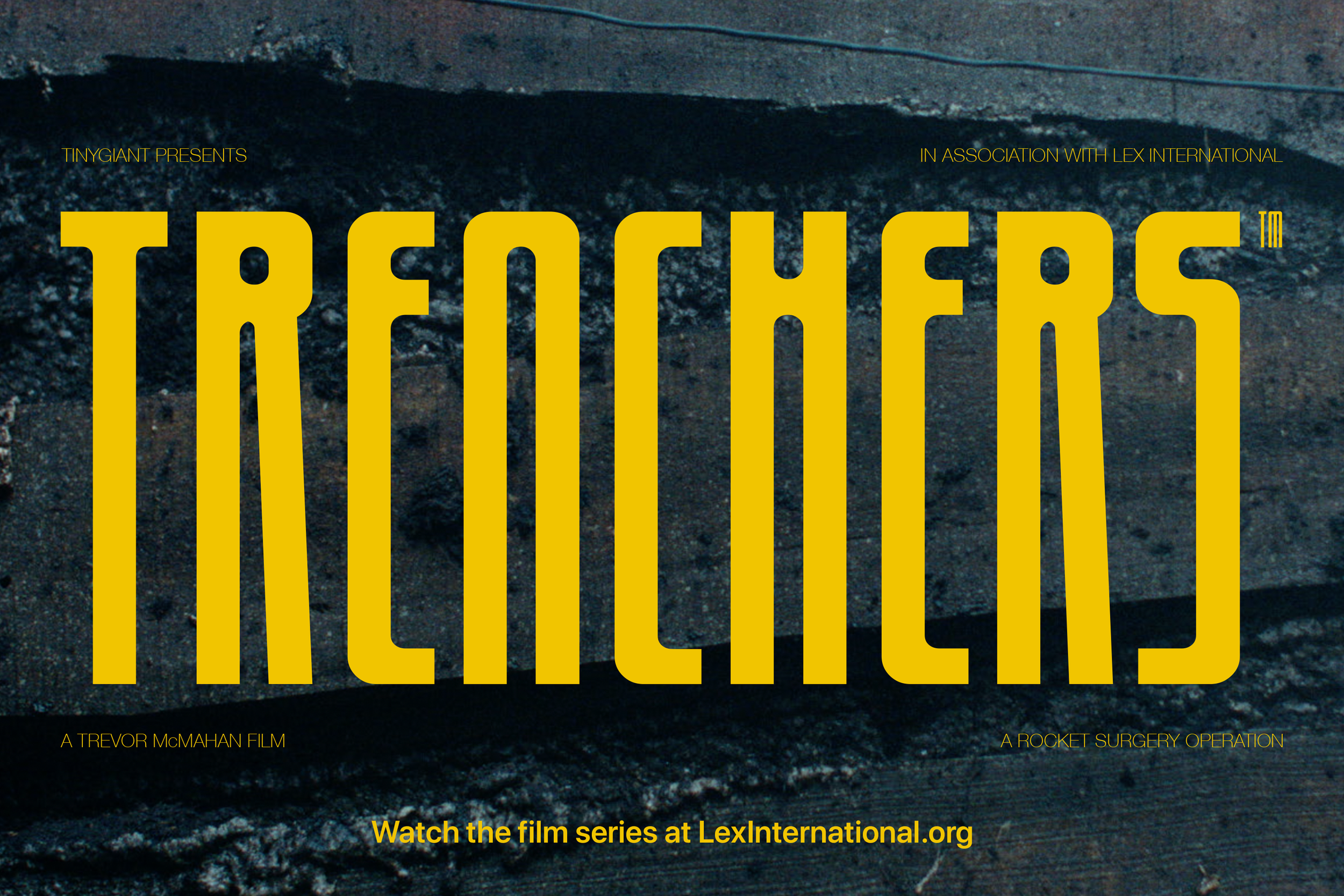
Trenchers is a five-part dark comedy series from Tinygiant and LEX International, written by Rocket Surgery’s Trevor McMahan and Blaine Kneece and directed by McMahan. In a single trench, a soldier, Bailey, is stuck with his AI comrade, Truman: eager, polite and completely out of his depth. Like a sitcom, each episode resets and starts again with a new and all-too-familiar AI failure, from acting before reading the instructions to answering a crisis with a list of tips and tricks, and every mistake costs a life. McMahan sets the comedy against stark war imagery: a contemporary but deliberately unnamed conflict, with each episode opening on the debris of battle. Every AI error is grounded in the real world rather than science fiction. Released one episode a day as states met in Geneva to decide whether to start negotiating a treaty on autonomous weapons, the series takes that debate to the public. We sat down with McMahan to talk about AI, casting and building the world of Trenchers.
Trenchers lands as states meet in Geneva to decide whether to start negotiating a treaty on autonomous weapons. Why did you choose a short episodic series to take this issue to a wider audience, rather than a single film or a campaign?
The goal of Lex International (led by my good friend Beatrice Fihn) is simple: to prove that international law beats war. And Beatrice knows firsthand how long a road it can be to get some of these discussions going. She accepted the Nobel Peace Prize on behalf of ICAN, the International Campaign to Abolish Nuclear Weapons, after the Herculean feat of getting 122 countries to adopt a treaty banning nuclear weapons.
Her point of view was that there isn’t a magic bullet, no one action or statement that will move the needle on its own. More sustained communication and persistent pressure are what make impact possible. So instead of one film, she suggested we try a few things, to have multiple at-bats, so to speak. Blaine Kneece, my writing partner, and I both love the sitcom format, so a cyclical workplace buddy comedy came naturally to us. And it was the perfect fit, because every episode could come at the issue from a different angle. Groundhog Day in a trench.
Trenchers is a critique of AI, so we’re curious about your own view of AI in production. How was AI used in making the series and was there a point where using it would have undermined what the series is saying?
Generally, I’m not an all-out AI hater. It’s a tool that can be helpful or harmful, depending on the use case. We use it all the time behind the scenes in production, especially to pre-visualize things we’re imagining but can’t find reference for. But we never let AI replace our own creative input. We’re not asking it to create… until, of course, we want to capture what an AI dreams!
Nothing you see in the first four and a half episodes of Trenchers was made with AI. We wrote the scripts, built the set, put the actors in real military gear and makeup, and shot it all for real. We had considered doing Truman’s six fingers in AI, but we even shot that in-camera.
The exception is the letter Truman writes for Bailey. Since the AI character was writing it, we thought it would be fun to actually have AI help write the letter and then generate all the imagery that goes with it. We edited and shaped the text of the letter, of course, but a lot of it came straight out of AI. And all the footage in the letter montage is AI-generated, based on AI’s “creative” interpretation of its own script. It was a really fun process, because we weren’t trying to fool anyone. The whole point was that it WAS generated imagery, like a window into an AI’s actual imagination. It came out so hilariously wrong that it was the perfect setup for the ending.
“Nothing you see in the first four and a half episodes of Trenchers was made with AI. We wrote the scripts, built the set, put the actors in real military gear and makeup, and shot it all for real. We had considered doing Truman’s six fingers in AI, but we even shot that in-camera.”
Writing an AI character meant studying how chatbots actually behave. How did you choose Truman’s lines and habits and did you test real tools along the way?
Well, we use AI all the time. It’s actually really good at summarizing, collating, and other non-creative tasks. And since our base insight was that the AI militaries are bringing onto the battlefield is the same kind of AI we use on our phones and laptops, our everyday use was all the research we needed. So we just started taking note of all the weird things it does: the em dashes EVERYWHERE; the constant “That’s a great question!”; how it always wants us to “delve” into things. We’d think, “Who says that??” And then we’d have a way into a scene. It gave us so much material we couldn’t come close to fitting it all into five episodes. We’ve got dozens more Trenchers scripts waiting patiently in the drawer, and in case you were wondering, AI thinks those scripts are “chef’s kiss”!!
Truman has to be eager, polite and dangerous all at once. What were you looking for in auditions, and what made Carson Davis the one? Bailey’s reactions, meanwhile, carry much of the comedy, often without a word. How much was scripted, and how much came from Brian Furey on the day?
Brian Furey and Carson Davis are seriously talented and brought so much to Bailey and Truman.
Most of the Trumans who auditioned went the direction you’d imagine for a chatbot: robotic movements, lifeless line readings, and very little behind the eyes. Some went in a more sinister direction. But Carson came in with a smile, and everything just clicked. His friendly eagerness felt so true to a chatbot, and that smile was the perfect way to hint at something sinister without making him a villain.
Meanwhile, you’re right that Brian’s reactions to his AI sidekick are at the heart of the comedy. Truman holding a grenade with no pin isn’t funny on its own. It’s Bailey’s reaction that gets the laugh. My writing partner Blaine has an incredible way with dialogue, so almost everything you see was scripted, down to the moments when a character stops in the middle of a line. At the same time, Brian has a gift for making things his own. There are a couple of moments where he goes off script, but even then it never feels like an actor launching into an improv routine. Everything was always rooted in character, and the humor came from his worn-down, hollowed-out, exhausted frustration.
Watch out, because these two are going to blow up!
“Truman is just a guy in glasses with a big smile, because the AI we’re worried about doesn’t look scary. It looks helpful”
Tell us about the look of the series. You avoided the polished, sci-fi killer robot style entirely. How did you balance the bleakness of war with comedy in the set and the visuals?
On paper, these scenes could read a little silly. But I wanted to feel an ever-looming backdrop of real life-or-death stakes. So the balance came from surrounding our characters’ little games with the gritty reality of actual war. That’s also why there are no glowing red eyes or chrome robots. AI isn’t science fiction anymore. Truman is just a guy in glasses with a big smile, because the AI we’re worried about doesn’t look scary. It looks helpful.
To pull that off, our cinematographer, Luca Fantini, and production designer, Jenny Burton-Akdag, were creative forces. It started with the set. Jenny is more-than-mildly addicted to Facebook Marketplace and was sourcing all kinds of real materials (fence posts, logs, sheet metal) that gave the trench an authentic base texture. But it’s the attention to detail that really sells the place: the comms lines, the grocery bag flitting in the breeze, all the little things that make it feel like a real war zone. The team did an amazing job, and if I hadn’t told you, you might not have thought we shot the whole thing in a studio.
Luca and his lighting team did a striking job of making it feel like we were out in the cold, hard reality of an overcast day in a trench. And once the lighting was set, we were able to shoot all of the episodes without any major (time-consuming) lighting changes, which was the secret to shooting as much as we did in such a short time.
Now that Trenchers is out in the world, what do you hope audiences take away from it?
Well, first, I hope people enjoy them. It’s why we make things in the first place. But while it’s fun to watch the cartoon logic of an AI’s flaws resulting in loss of life (like Road Runner and Wile E. Coyote)… the finality with which the series closes out is the point. These films were made to draw attention to the truly frightening issue of autonomous weapons, and we released one a day during the Seventh Review Conference of the UN Convention on Certain Conventional Weapons (CCW), to add pressure while governments decide whether to start negotiating a treaty. Spoiler alert: the United States and Russia would rather spend five more years talking about guidelines nobody has to follow.
Ultimately, I hope viewers know their voices DO matter. They can sign the Stop Killer Robots petition. They can write to their country’s representatives in Geneva. All of that information is on the Lex International site. I know there’s a lot of issues out there, and we can’t fight for everything all the time, but I feel like this is one of those no-brainer issues that unites people –AI should not be allowed to kill people.
Starring Brian Furey, Carson Davis
Directed by Trevor McMahan
Written by Blaine Kneece & Trevor McMahan
Producers: Sara Eolin, Veronica Diaferia
Executive Producers: Beatrice Fihn, Sara Eolin, Veronica Diaferiaì, Neil Champagne
Unit Production Manager: Christina Donahue
Executive Assistant: Danielle Marcott
1st AD: Mark Kaufmann
Cinematography: Luca Fantini
Production Design: Jenny Burton-Akdag
Wardrobe: Cherish Cullison
Hair and Makeup: Ana Crane
Casting: Henry Russell CSA
Editorial and Post by Hooligan
Editor: Eric Carlson, Henry Carroll
Assistant Editor: Malia Kiang
Lead Visual Effects Artist: Raúl Ortego
Assistant Visual Effects Artist: Emma Cooney
Motion Graphics Animator: Damien Oramas
Managing Director: Rosemary Quigley
Post Producer: Abigail Best
Audio Post by Sound Goods
Sound Design & Mix: Hillary Kew Martell
Executive Producer: Angelina Powers
Producer: Acacia McDonough
Color: Kody Wescott
Special Thanks:Will Fihn Ramsay, Amalia Luyet-McMahan, Lisa Goore
TINYGIANT presents
In Association with Lex International
a ROCKET SURGERY operation