IN MY HEAD
A meditation on the porous space between thought, memory and the world around us
Directed by Lola Margrain
words by Isabella Bazoni
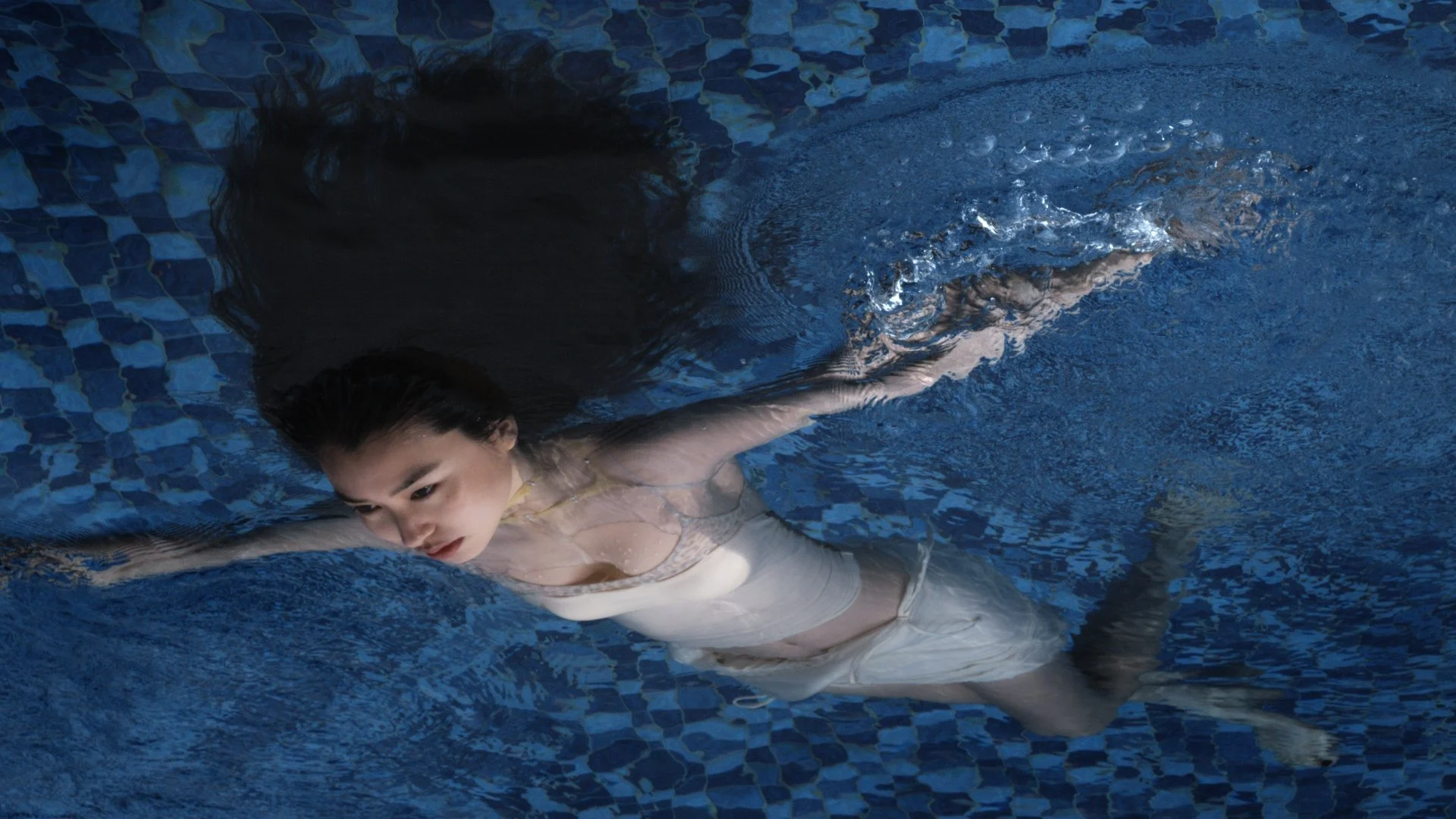
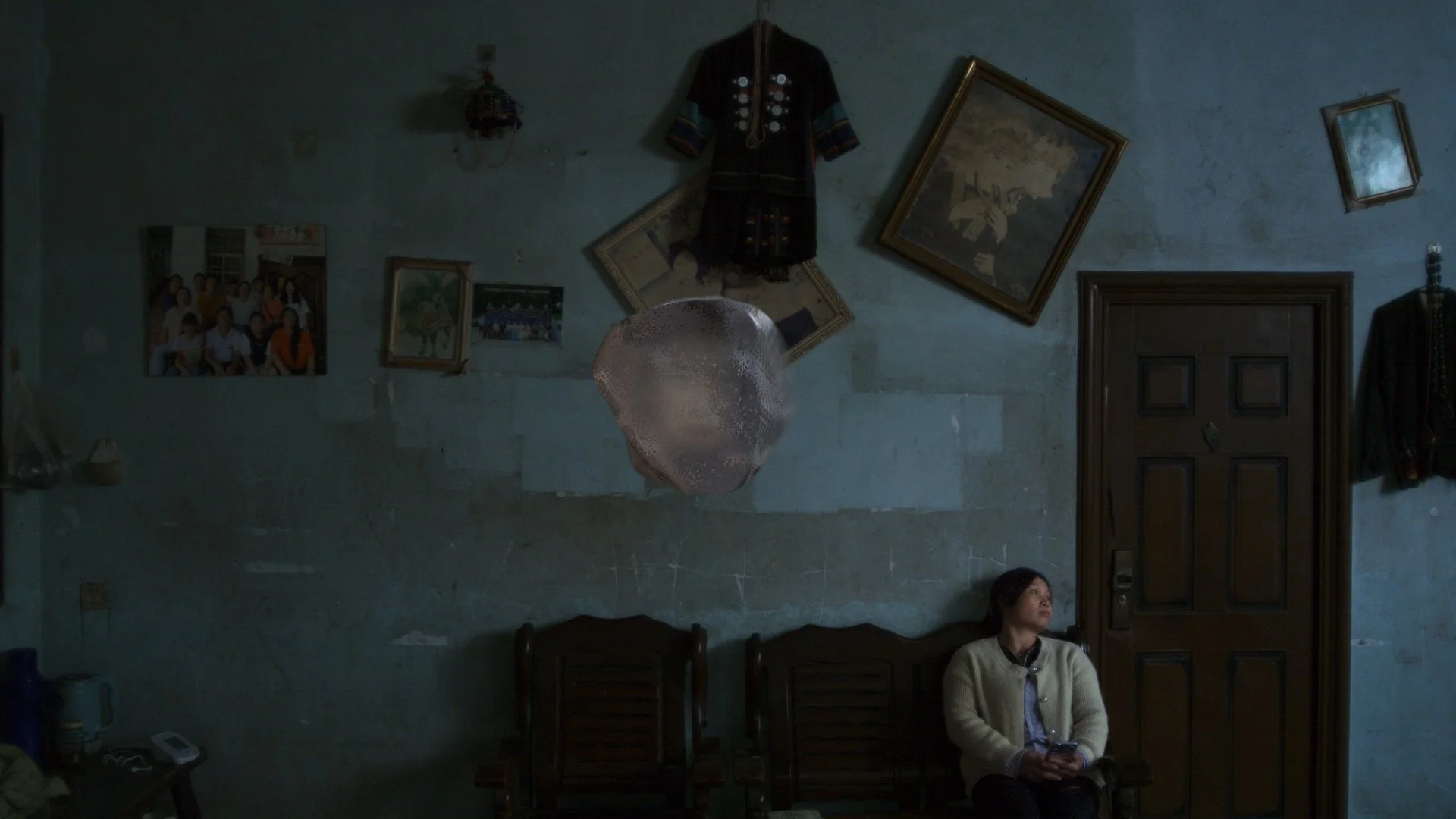
In In My Head, director and editor Lola Margrain turns an internal state into something physical. Made for musician Estelle Chen’s single, the film begins in a suspended interior: a sleeping body, a pool of water spreading across the floor, and a small bubble emerging from Estelle’s head. From there, we gradually slip beyond the confines of the room, moving through a swimming pool and into the landscapes of Yunnan, where flowers, water and natural forms begin to respond to the thought that has escaped her body.
Margrain makes nature part of the film’s psychology, allowing the boundaries between body, memory, dream and landscape to become increasingly porous. It is a visual language that reflects the director’s wider practice, which moves between realism and speculative imagination, using live action and post-production to make familiar spaces feel subtly unfamiliar.
The film moves seamlessly between physical space and a mental one, yet it never feels the need to explain itself. Even as the imagery becomes more surreal, there's a real sense of restraint. How did you find that balance, and how do you know when an image has said enough?
The starting point was quite simple. The idea of a bubble emerging from Estelle’s head and travelling through the city, then into nature, came to me very quickly. I also wanted the film to move gradually from an enclosed interior towards the outside world, until it surrendered to it entirely. From the beginning, there was therefore a movement of expansion: as the bubble took physical form, it opened a passage towards the outside, but also, paradoxically, towards a revealed interiority, where dreaming and waking overlap. In the scene where the bubble emerges from her head, Estelle watches herself sleeping; we understand that these two layers coexist.
I think the sense of restraint comes from the fact that the surreal emergence never suspends reality or announces itself as an event. The world carries on around it. I wanted the transformation to remain ambiguous, so that we never fully know whether Estelle is projecting her inner world onto nature, or whether nature is dreaming through her.
Knowing when an image has said enough is quite instinctive, and a lot of it happens in the edit. That is also why I find this stage difficult to delegate. It is an almost physical moment, when I can feel the path the images need to take and the precise point at which they provoke a sensation in me. When I feel that sensation, I know I have to stop. Images carry emotional charges that seem to seek one another out; the process is about finding a way for them to meet, and that encounter often shows me the way forward. It is quite a sensual process.
Your work often blends live action with digital intervention, but the effects never feel separate from the image itself. At what stage do those ideas begin to take shape, and how closely do the shoot and the edit inform one another?
Symbolic ideas, often the ones involving digital interventions, tend to come to me most intuitively. My mind works very much through association. The key is to understand what they are saying. It is very subconscious, and I like to leave it in that state. Most of the time, the work consists of developing that idea, image or sensation, allowing it to pour into the film and seeing where it leads me, or even sinking deeper into it.
In In My Head, the idea of the bubble (developed in VFX by Leslie Camara), was present from the writing stage as a mental form made physical. Its appearance was then refined during the edit: it begins as a light, almost childlike sign that retains something dreamlike, before becoming stranger, more organism-like, with a slightly alien presence.
“Images carry emotional charges that seem to seek one another out; the process is about finding a way for them to meet.”
The film feels less driven by narrative than by association, with one image naturally giving way to the next. How did you develop that rhythm, and were there any films, artists, or other references that shaped your approach?
The film unfolds like a dream already in progress, following a gradual descent into matter. It advances through continuous transformations, in the same way that dreams do. Before we left for China, I already had the idea of the bubble and of the final waterfall filmed day-for-night, but a great deal still remained to be defined.
Once we arrived in Yunnan, a lush region in south-western China, close to Thailand, the places, the people and the natural surroundings gave me so much. Sometimes, the atmosphere of a room or the way someone inhabited a place was enough for something in the film to materialise in my mind. The film wouldn’t have been the same if we had shot it elsewhere. Almost all of the interior scenes were conceived there.
It became a way of staying constantly alert to whatever stirred something in me, then following that impulse through what I encountered: a place that drew my attention, the curtains of a house glimpsed from the car that I immediately wanted to enter. I loved working this way, and found the region deeply inspiring, with a real charge to it.
I had only just discovered Mirrored Mind by Gakuryū Ishii before the trip, and I had loved the feeling it left in me. It was certainly an inner climate that accompanied me throughout the shoot.
Water becomes the thread that connects the entire film, carrying us from an office floor to a swimming pool and eventually into the landscape. When did that motif emerge, and how did it influence the way you structured the film?
Water was central to the project from the beginning, because I very quickly imagined Estelle standing in a waterfall filmed day-for-night. The scene in which she pours water onto the floor also appeared early on. What followed was intuitive. When it comes to dreams, water asserts itself quite naturally because it lets one state glide into another without a clear rupture. It suspends all points of reference, blurs contours, and allows several levels of reality to coexist. In the film, it connects the spaces and gradually extends this intimate gesture into a larger movement, until it becomes a passage, a mental surface, then a territory.
“I am fascinated by everything that exists in intermediate spaces, between things: the invisible connections between people, objects and environments, transformations, whatever passes through us and moves us from one state to another.”
Your films often sit somewhere between observation and imagination, where familiar spaces begin to feel slightly unfamiliar. What keeps drawing you back to that threshold, and what does it allow you to explore as a filmmaker?
I think it was through exploring it as a filmmaker that I gradually realised it was something I kept returning to, a territory that had emerged naturally rather than consciously. I do not know exactly what keeps bringing me back to it, but I have very early memories of spaces and objects suddenly no longer seeming as they were, taking on a living charge, as if they were coming alive. Today, I connect these experiences to forms of dissociation. As a child, they simply remained nameless, like mysterious suspensions. I think they certainly shaped my imagination.
I am fascinated by everything that exists in intermediate spaces, between things: the invisible connections between people, objects and environments, transformations, whatever passes through us and moves us from one state to another. I have an animist vision of the world, in which landscapes, objects and materials are presences capable of receiving, responding to and transforming whatever passes through them. I often dream that people, usually those closest to me, are embodied in spaces, sometimes becoming the walls of a house, or that a part of me exists in an undiscovered room in my apartment.
In my films, I think I am looking for the moment when something other than the character acquires a force of its own, when that person’s inner sensation begins to enter the space, or when a body reveals that it already contained a territory. My language lives in the things emotions come to take shape in.
director — LOLA MAR GRAIN
production company — HIER SOIR
director of photography — NICOLAS JARDIN
executive producers — ESTELLE CHEN, STANFORD LIN
producers — CAROLINE HELAINE, YOËL SERVADIO
production coordinators — VIVA YAO ZHI, BAPTISTE ARCHIMBAUT
makeup artist — XIAO TANG XU
1st AC — LIANG ZHAO
focus puller — LIAN FENG DU
lighting assistant — CHAO LI
editor — LOLA MAR GRAIN
additional editors — LÉO LAROUR, WILLIAM BORGUE
VFX artist — LESLIE CAMARA
VFX assistant — LEOPOLD WU
colourist — MARINE SURBLÉ, LES FILMS DU PÉRISCOPE
graphic designer — BRIAN MARK
set photographer — HANG XIAO
drivers — FU KUN MA, QI YOU XU
music written by — ESTELLE CHEN, STANFORD LIN
music produced by — STANFORD LIN, NOAH LI
mixed by — ERIC LAU
mastered by — ERIC LAU