LEONARDO’S HORSE
A Renaissance dream reimagined through anime
Directed by Yibi Hu
words by Katie Huelin and Isabella Bazoni
Everyone knows Leonardo da Vinci. Fewer know he spent nearly twenty-five years in Milan—dreaming, sketching, and inventing. Leonardo’s Horse brings one of his most ambitious ideas to life, transforming a centuries-old vision into an anime that bridges time, place, and imagination.
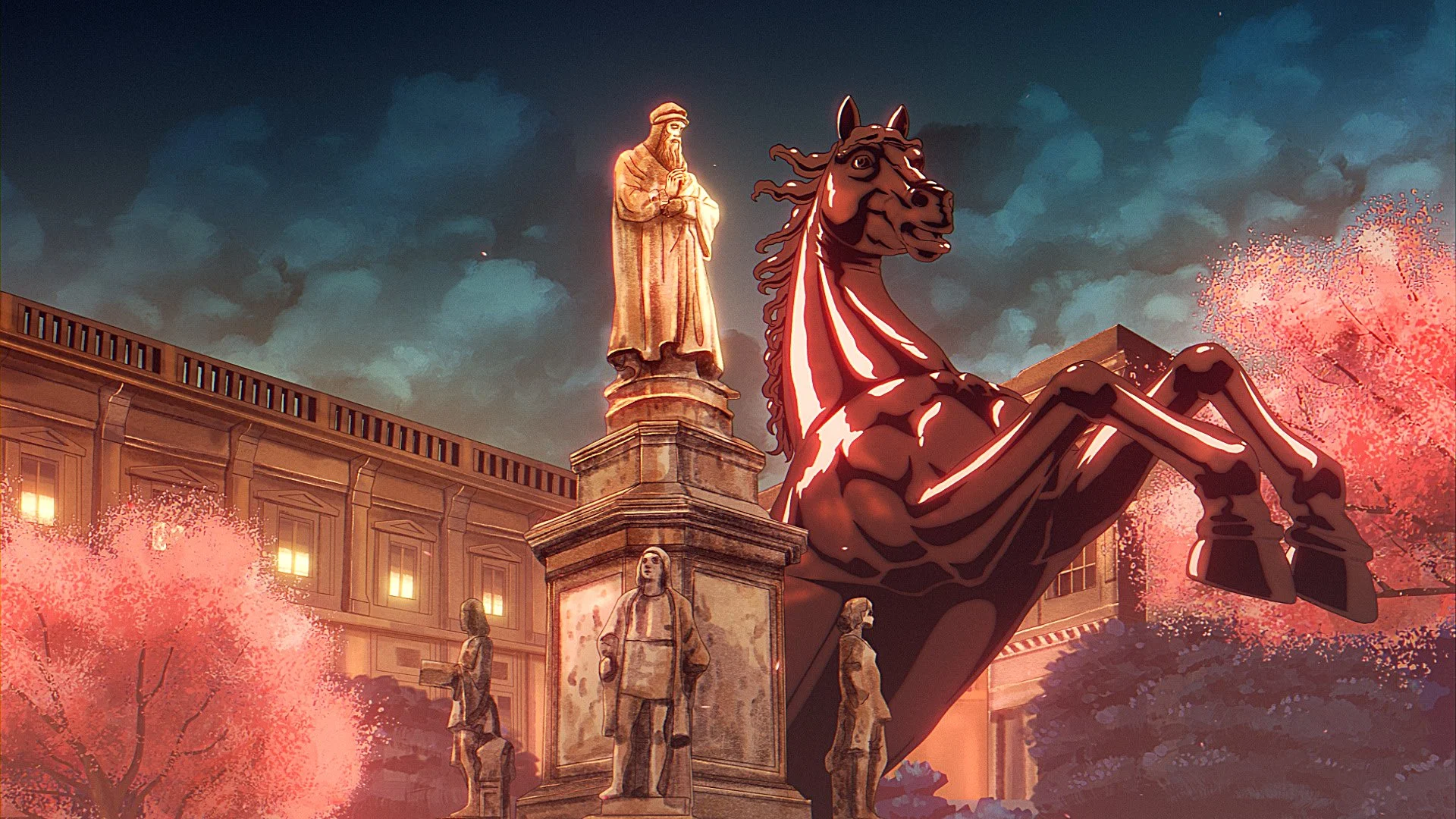
Inspired by the exhibition of Leonardo’s Milanese masterpieces at the Italy Pavilion at Expo Osaka 2025, the film traces the journey of a colossal equestrian dream that survived centuries in sketches, plans, and ideas, finally finding form in the language of animation. Across luminous cityscapes, intricate designs, and intimate gestures, the story honours both the enduring spirit of Leonardo and the layered, lived experience of Milan itself.
Alongside the animation, the project was extended into a manga, created in collaboration with the Milan-based studio Frankenstein Magazine and illustrated by Vincenzo Filosa. Titled Leonardo’s Great Grandsons – a mecha roundtrip to Milano, it was produced as free press for Expo 2025 and follows the journey of a mecha traveling from Japan to Milan in search of its roots. For the film’s premiere in Osaka, a comic book was also created as a special collectible. Through this extension, the team explored a new way of imagining the city while passing Leonardo’s legacy on to a new generation.
Created by The Cuddly Pets of Komodo for YesMilano and directed by Yibi Hu, Leonardo’s Horse is a meditation on memory, invention, and imagination — where the past meets the present, and the city becomes both stage and character, inviting viewers to experience history as a dream lived in motion.
Leonardo’s Horse takes a Renaissance dream and filters it through the language of anime. What drew you to telling this history through something so poetic and imagined?
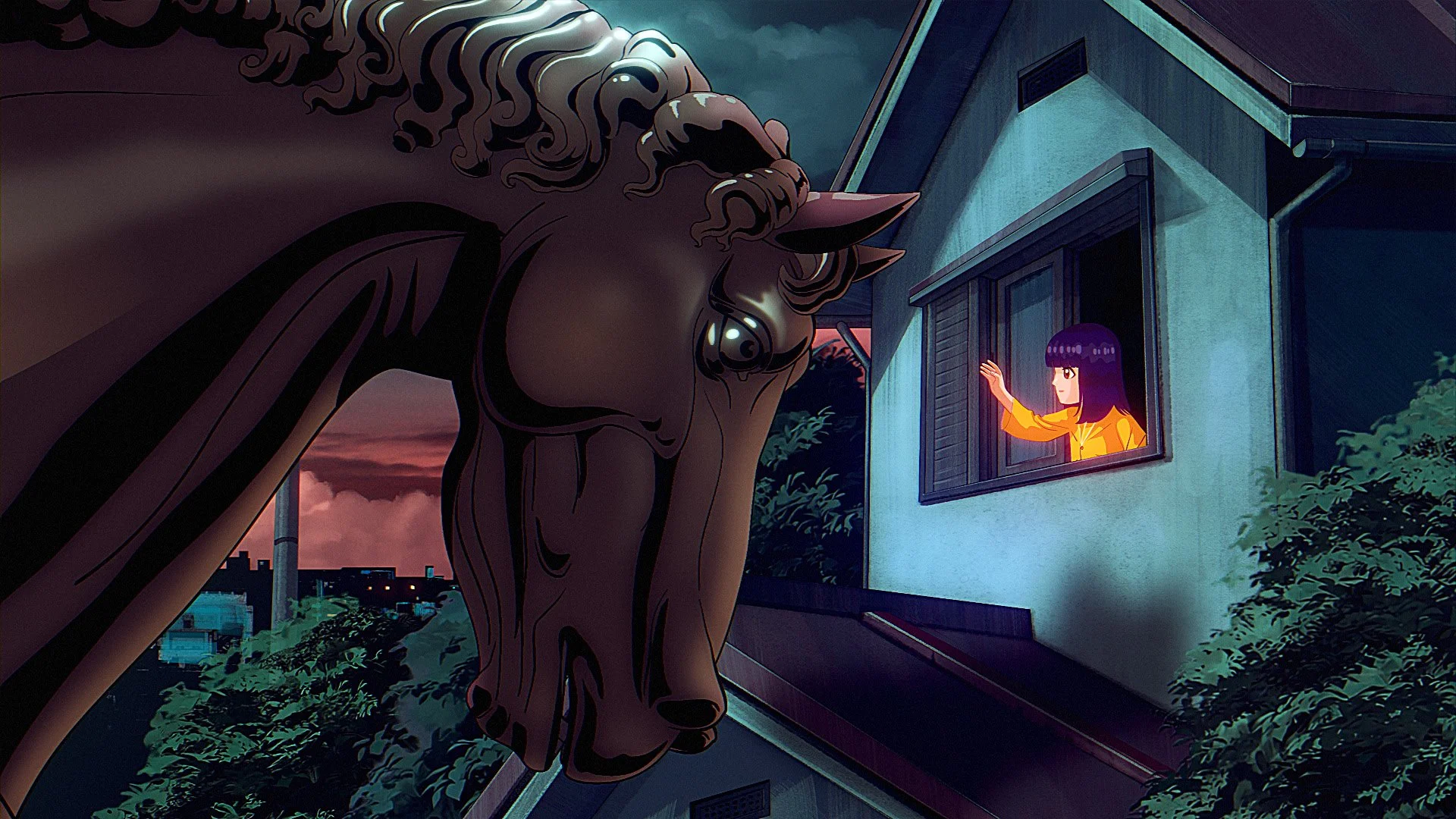
The choice is directly connected to Expo 2025 in Osaka, where Leonardo’s Codex Atlanticus was presented. But beyond context, the horse itself is a dream that survived time: Leonardo spent years designing a colossal equestrian statue for Milan—studying anatomy, movement, and casting—yet the horse was never realized in his lifetime. It remained an unfinished vision, carried forward through drawings and ideas for over five centuries before finally taking physical form. That endurance made the horse feel less like a monument and more like a dream.
Dreams don’t follow the rules of realism—they move through intuition, memory, and emotion. Anime gave us the freedom to work in that space. Its visual language allowed us to approach the story not as historical reconstruction, but as an experience shaped by feeling and imagination. In that sense, animation wasn’t a stylistic choice; it was the most truthful way to give form to a dream that has continued to exist across centuries.
“Dreams don’t follow the rules of realism—they move through intuition, memory, and emotion. Anime gave us the freedom to work in that space.”
How did crafting a story about Milan, your own city, shift the way you approached world-building and symbolism?
Working on Milan, in Milan, meant experiencing a multiplication of the city. There is the real Milan, the one we walk through every day. Then there is an interior Milan—the city shaped by memory, emotion, and personal history. And finally, there is the imagined Milan that emerges when those layers overlap.
Nighttime Milan played a crucial role. At night, the city becomes more intimate, more yours. Fog, artificial light, silence—everything opens into another dimension. Through that lens, many Milans coexist: Leonardo’s Milan, Veronica’s Milan, Lorenzo’s Milan, and even the Milan of childhood.
World-building became an act of listening—to the city as it exists, and to the city as it lives inside each of us. That approach extended beyond the film itself. Together with Passion Pictures and Future Power Station, these layered interpretations allowed Milan to escape familiarity and become something new again.
Alongside the animation, we imagined an extension of the project in the form of a manga, created with the Milan-based studio Frankenstein Magazine and illustrated by Vincenzo Filosa. Titled Leonardo’s Great Grandsons – a mecha roundtrip to Milano and produced as free press for Expo 2025, it tells the story of a mecha traveling from Japan to Milan in search of its roots. Through this journey, we found another way of dreaming the city and passing Leonardo’s legacy on to a new generation.
Working with director Yibi Hu and the animators at Future Power Station and Passion Pictures introduced another layer of interpretation. How did that collaboration unfold?
The collaboration felt simple and natural, and it allowed us to introduce another vision of Milan: that of someone who has never lived in the city, and is therefore freer to imagine it. Yibi Hu brought a gaze shaped by a different cultural and visual heritage, and that distance proved invaluable.
Seeing Milan translated through his sensibility—and through the hands of the animators at Future Power Station—allowed the city to escape the weight of familiarity and become something new again. The collaboration was built on trust and openness. We weren’t trying to protect a fixed image of Milan; we were giving it permission to be reimagined. That external perspective gave the film its sense of wonder—like rediscovering a place you thought you knew by heart.
As a creative director and producer on the project, what part of shaping this film felt the most personal for you?
As writers and creative directors we felt deeply honored to translate the story of one of humanity’s greatest minds into an animated form.
The most personal moment came when we encountered the Codex Atlanticus for the first time. Standing in front of those pages, we were overwhelmed by a sense of reverence—almost a feeling of holiness. They aren’t just documents; they are traces of a restless, searching mind. They are one of the purest expressions of human curiosity: perhaps one of the most sacred things in our earthly experience.
That feeling guided the entire process. It shaped our restraint, our ambition, and our responsibility. We weren’t just telling a story—we were listening to one that had been whispering for centuries.
Another moment remains especially vivid. Seeing the very first still frames produced by Future Power Station was deeply emotional. Watching our city reimagined through the visual language of Japanese animation was both surprising and exhilarating. One image in particular—the silhouette of the gigantic horse illuminated by neon lights as it crossed the fountain in front of Sforza Castle—made it clear that the film could surpass even our highest aesthetic expectations. It was the moment we truly understood the scale of what we were creating.
“Seeing our city reimagined through the visual language of Japanese animation was both surprising and exhilarating.”
You founded your own studio and you teach the next generation of creatives. How do projects like Leonardo’s Horse feed back into your creative philosophy and the way you guide younger artists?
Projects like this reaffirm a belief we try to pass on every day: creativity is not about speed, trends, or immediate results—it’s about depth, curiosity, and patience.
Leonardo’s story reminds us that ideas can take a lifetime—or even many lifetimes—to be fulfilled. That’s a powerful lesson for young creatives living in a culture of urgency. We encourage them to protect their curiosity, to accept uncertainty, and to trust that meaningful work often unfolds slowly.
Teaching, like filmmaking, is an act of cultivation. You don’t force growth—you create the conditions for it.
What’s next for you?
We’re a brand-new studio, so this year is both exciting and challenging. We are launching a new project dedicated to the city of Milan, combining design, illustration, and social media. We’re currently developing and applying for several new projects—some in animation, others in documentary—and we’re building our slate step by step.
What gives us confidence is the experience behind the studio. While The Cuddly Pets of Komodo is newly born, it carries more than twenty years of creative leadership across global ad networks. That allows us to move with the agility of a boutique studio, while still thinking at scale.
Across all these upcoming projects, we continue to work in that liminal space where truth becomes stranger than fiction, crafting stories where imagination, impact, and respect for people and the planet can coexist. For us, each project is a new ecosystem—and we’re always curious to see what kind of creature will emerge next.
client - YESMILANO
creative studio - THE CUDDLY PETS OF KOMODO
creative directors - LORENZO CRESPI, VERONICA CICERI
production company - PASSION ANIMATION
director - YIBI HU
executive producer - BELLE PALMER
creative producer - EVE SOMERVILLE
producer - VERONICA CICERI
animation studio - FUTURE POWER STATION
2d animation - KRISTIAN PIOTR GARSTKOWIAK, DAISY ANNA EVANS
3d animation - KEVIN O’SHEA
music & sound design - SMIDER