TENDER
A rotating tower of excess, tracing the slow construction (and collapse) of modern society
Directed by James Siewert
words by Isabella Bazoni
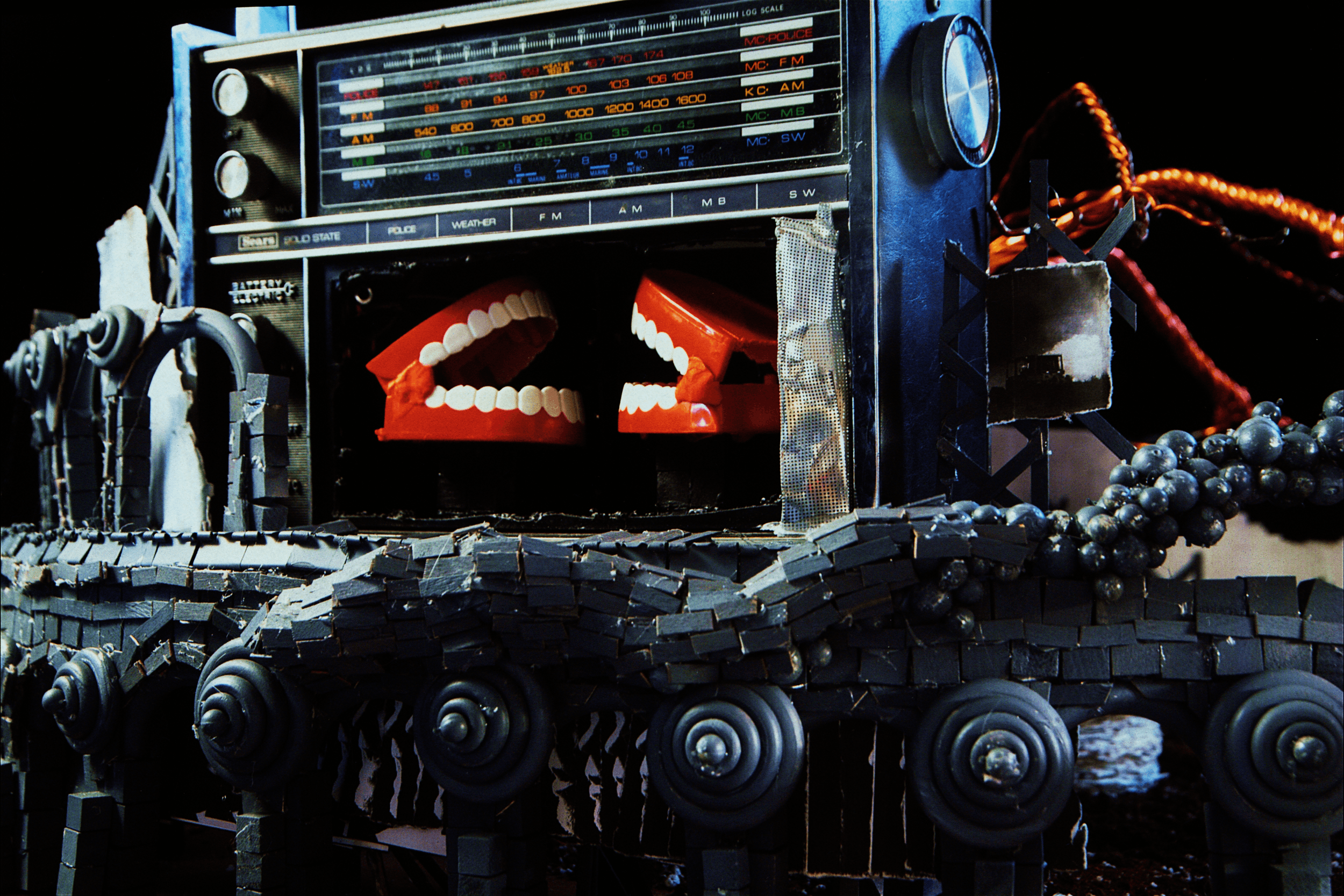
In Tender, director James Siewert constructs a constantly rotating world where accumulation never stops. Created for Larry Fessenden’s project Just Desserts, the stop-motion video builds a tower that grows, mutates, and gradually edges toward collapse. What begins as a simple sculptural idea expands into something denser and more chaotic—highways, buildings, and symbols stacking up into a system driven by excess.
Working from a single, continuous motion, Siewert lets the piece evolve organically, responding to materials and ideas as they emerge. The result feels both playful and uneasy, a hypnotic cycle of construction and decay that mirrors the fragile balance of the world it reflects.
The music video is built around a continuous rotational movement. How did you and your team technically design and stabilise this system across such a long and evolving shoot?
The platform is screwed into a large lazy Susan bearing from Amazon. I’ve used these lazy susan bearings a lot in rigs of different kinds. There’s an A-Clamp that holds the platform in place. You can see the clamp in the left corner of the frame when the camera is zoomed out all the way. You can also see the angle markers in Sharpie on the base in certain parts of the video. I like the idea that the viewer can peak behind the curtain - a little - while watching.
A lot of stabilization was done after the fact. The final two weeks of post production was mostly just a lot of tracking and stabilizing in After Effects. It’s still not that stable. How charming you find that is a matter of taste, I suppose.
The transition between stop motion and live-action fire feels deliberately disruptive, almost breaking the visual language you’ve established. How did you approach blending these formats in post-production while still preserving that sense of rupture?
Well the idea of the fire was Larry Fessenden’s - the musician and also founder of the Indie horror production company Glass Eye Pix. He felt strongly that there needed to be some big act of violence at the end. Walker James White - the guy that produced this animation - and really was co-creator of the whole thing, and I talked about how to incorporate this fire. I felt like the rotation of the platform was part of the thing that kept the video engaging - this quality of keeping it all feeling like the whole video existed in one breath of movement. Walker conscripted his friend Oz Hewett to program the motor spin at the same speed that we had been doing the stop motion so that it felt continuous.
What was really dumb of us is that we put the motor on the same breaker as the lights that went into the dollhouse set that was burning. When those lights ignited it tripped the breaker and the motor turned off. So Larry pushed the burning platform around with a shovel and we got a few different angles of the thing burning. This is one of those things where you can either see it as a happy or unhappy accident - the fact that the spinning stops at the very end feels like an additional disruption - the form itself breaking as the world burns. On the other hand it's hard to really compare it to the counter factual situation where the platform had continued to turn - it might have felt more cohesive. One of my bugbears in film production is the little white lies we tell ourselves of this or that catastrophe really being “for the best” - because you can’t actually directly compare it to the situation if it had gone according to plan. What you can say is just that you adjusted your concept to circumstances as they unfolded.
“When you’re bouncing around that much you end up thinking about the reality and atmosphere more than the narratives of the things within it.”
Sound plays a huge role in reinforcing the hypnotic, almost trance-like quality of the piece. How closely did you collaborate with the sound designer to shape the rhythm and atmosphere beyond the track itself?
It’s just Larry’s track! For the beginning and end I found some room-tone that I liked from Freesound.com but other than that it's nothing but music!
There’s a real tactility to the materials and miniature builds throughout the video. How did your production design process evolve as the structure grew, and how much of it was planned versus discovered in the moment?
I think pretty soon as I got into it I discovered how much I liked working with wooden coffee stirrers as the main construction material besides the blocks. Coffee stirrers really are so much fun to work with - they are smaller and easier to cut than popsicle sticks and they don’t have those annoying rounded ends. You can make anything out of Coffee stirrers and hot glue!
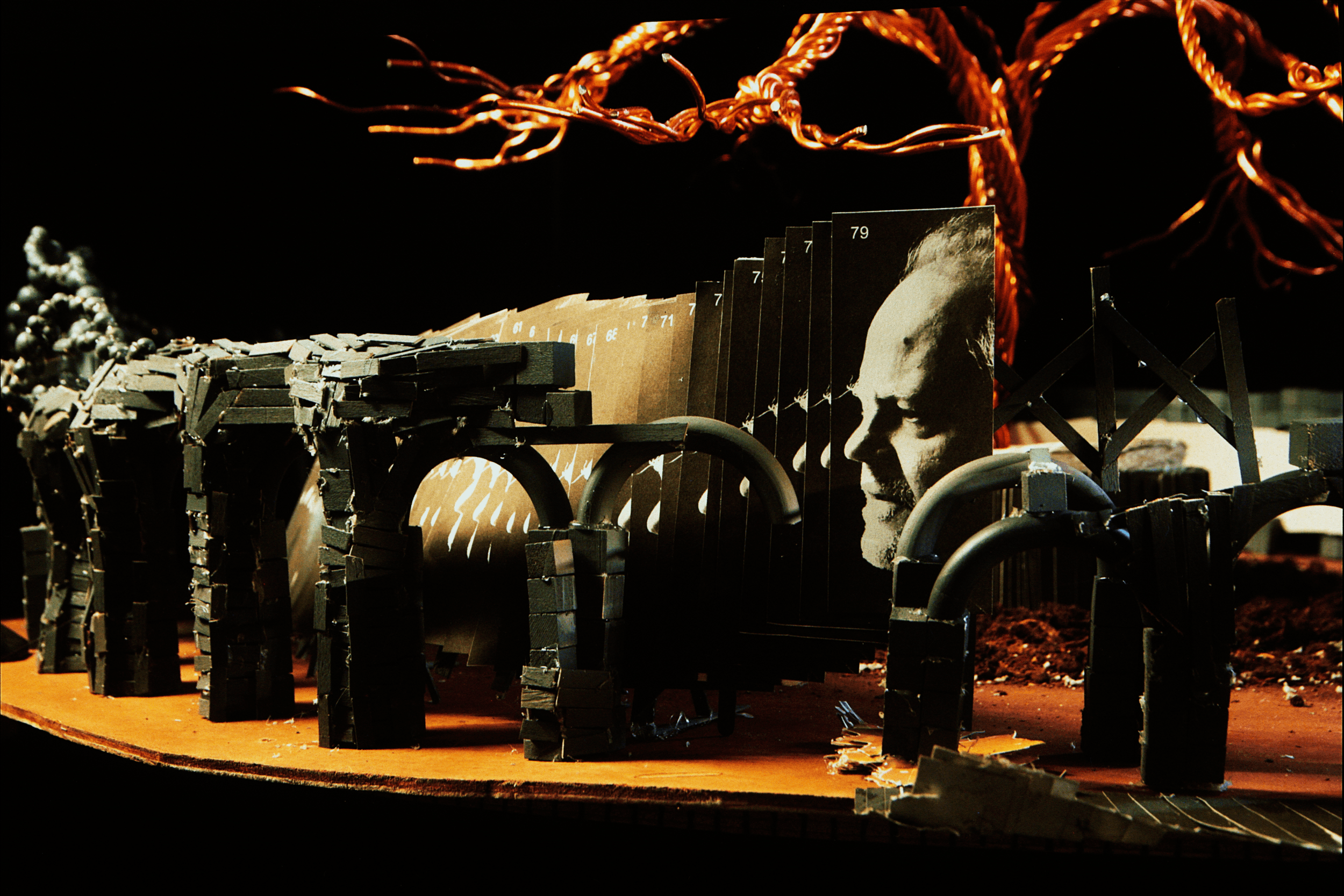
One thing about the video is that you can kind of track me learning how to make it as it goes along - the first time around the tower is definitely pretty rough - you can’t really see Larry singing through the arches, and things haven't found their place in the frame. Once we got the second level I felt like I’d mapped the territory a bit more - I knew where the arches should grow while leaving an area of frame open for whatever doodads were center stage lyrically.
The whole first part of the video was such a mess that I basically redid it in post-production - the title sequence and such was done at the very end of the process.
Colour and texture shift quite subtly as the piece progresses, almost mirroring the narrative arc. Can you talk about your approach to grading and how you brought all these varied elements into a cohesive visual world?
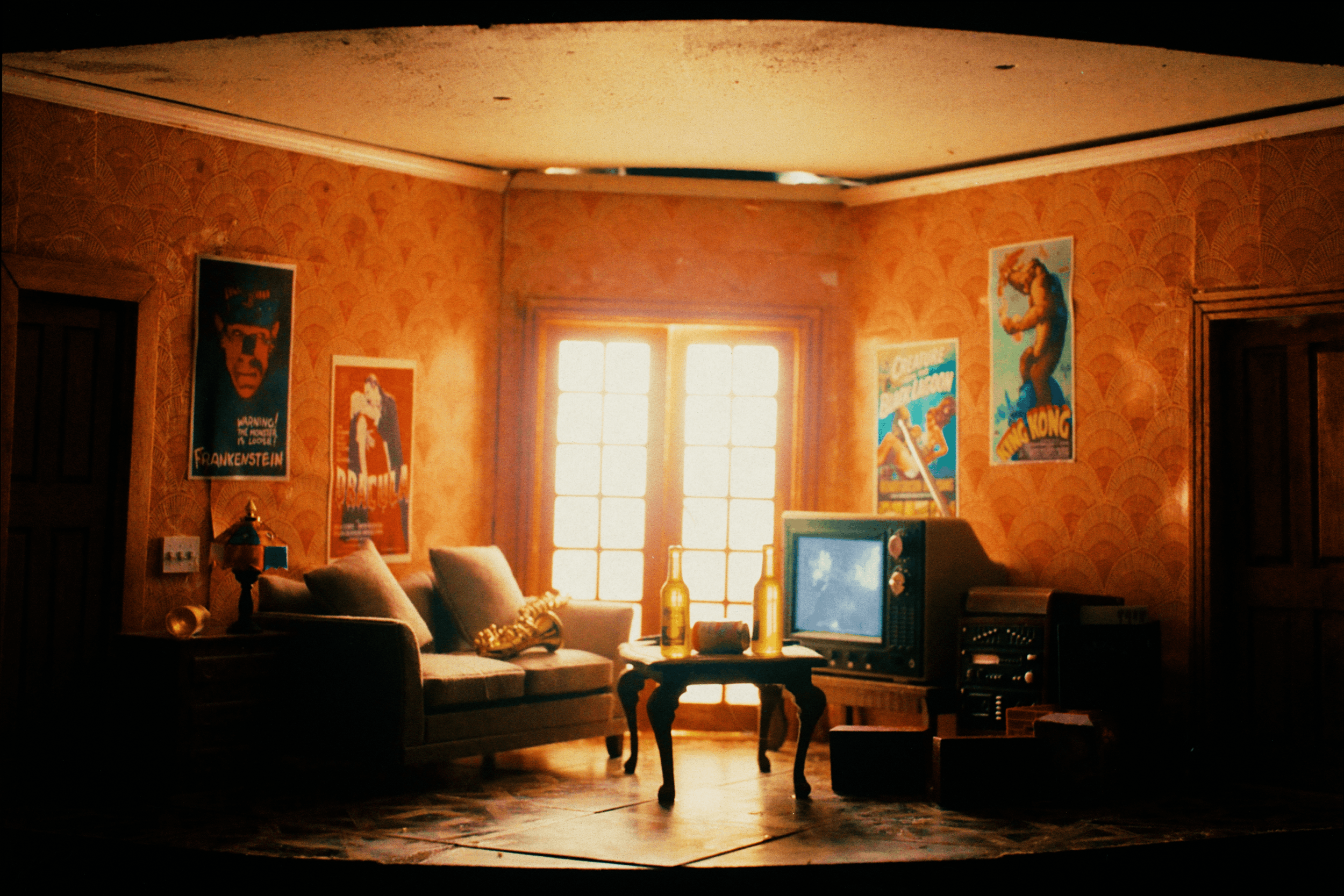
Like a lot of things it was discovered as we went along. I think I’d made a bunch of very technicolor videos before this so I wanted this to be a more selective palette. It felt like the tower itself should be gray and sort of monochromatic - like this Kurt Schwitters looking thing - and then the outgrowths could be more these pops of yellow, orange and gold. And then that warmth takes over I guess in the nostalgic past part, and ultimately the fire. I’ve always liked the color in that Aronofsky movie The Fountain. So I was sorta going for that.
But it didn’t really start that way - I originally had the LEDs set to green and blue and then just kept fucking with them as the video went on untill I hit the more neutral lighting that I ended up preferring. One thing I did in post production is recolor the beginning so it wasn’t so all over the place.
“Everyone at some point has an experience where everything is one way, then suddenly another with no warning—just sudden transformation.”
Editing something continuous and loop-like, without a traditional narrative structure, comes with its own challenges. How did you approach pacing and shaping the piece so it still feels engaging and intentional?
There was a rough - and I do mean rough - animatic/mood board thing that I made at the beginning where I took the track and just threw references and extremely crude 3D mock ups. I think the cash register was one thing that I knew would be a turning point of the song from the outset, and so we shot plates of Larry singing that we knew we would turn Presidential (not that that means anything anymore).
But like I said me and Walker talked through what was coming up - how it could be more interesting, and I think a lot of the initial ideas that didn’t fit - I was originally going to do something with long exposures and light painting - just naturally fell out because we got more excited about something else. Like when we started the freeway it felt very natural that buildings and a city would start to build up. The song is really about excess and appetite so it felt natural to follow those instincts when animating.
That being said I do think that oftentimes a “oner” style video is assumed to be more technically demanding or impressive than videos which are created in the edit. It feels like in some ways the opposite is true - getting an idea that can kind of be attacked in one fell swoop is in the biggest favor you can do for yourself in terms of actually completing a project - because it instantly creates guardrails - and no matter how crazy and ambitious an idea is - it's still one idea. I find editing terrifying - when you have 20 different ways that something could be cut - it's easy to be overwhelmed with the possibilities, and easy to second guess yourself. I’d rather push at the edges of a small sandbox than get swallowed up by a big one.
The project feels deeply collaborative across multiple disciplines. How did input from different departments influence the creative direction as the video developed?
This wasn’t a traditional film shoot with department heads or really any of that kind of organization. Really it was more of just an art project that for 90% of the time was just something that Walker and I chipped away at. So most of the ideas came out of us bullshitting in the studio and talking about life.
That being said - there are definitely people that were incredibly generous and left a lovely mark on the video: Ruth Lichtman started us out strong, helping with the title sequence. Auden Lincoln Vogel mounted the cash register and did the little animation of the car exploding right before. Then, at a certain point we had to just get the tower done (there a pretty big jump between how it is shown at the time of the cash register and its “final form” at the very end of the video. Walker has a connection to this great art studio in Bushwick - Godspeed Arts - he organized a few pizza parties with his friends from Godspeed and we finished it in a sprint. In particular shout out to Jacqueline Brockel and Emma Bautista for blasting through the “crown” of the tower - the three top most levels - in a matter of a couple hours. Then for the dollhouse burn we were having trouble getting the fire evenly distributed with the lighter fluid alone - and resident pyro Beck Underwood came in hot with the idea of hiding little balls of toilet paper soaked in lighter fluid throughout the structure. Brent Green wired our little miniature lights.
When you are dealing with a project like this that doesn’t have a real budget I think it is much easier to ask someone to come help with a task then to fulfill a role. Even when you can pay a little (I’ve never been able to pay someone more than a little) I think it's better to be task-based than role-based. Because, for myself I find it's easier to get my head around “Hey we really need your help with this shot - the camera needs to move in X or Y way, and we think you could figure it out!” Then I’m immediately in the weeds problem solving about something I’m interested in. Versus being like “Hey do you want to shoot our low budget video?” - well then I feel like I’m expected to have some general vision for the whole thing - rather than planting a seed and letting it grow. The truth is - when you get a talented person to devote themselves to solving a thorny problem - their vision and insight comes for free - that’s the engine they will use to solve the problem. But if you ask for their vision and insight directly they will often draw a blank.
director — JAMES PARK SIEWERT
cinematographer — JAMES SIEWERT
producers — JAMES SIEWERT, WALKER WHITE, LARRY FESSENDEN
animators — JAMES SIEWERT, WALKER WHITE, EWAN CREED, RUTH LICHTMAN, LILY RAND, AUDEN LINCOLN VOGEL
motor programming — OZ HEWETT
art department — JAMES SIEWERT, WALKER WHITE, EWAN CREED, LILY RAND, JACQUELINE BROCKEL, EMMA BAUTISTA, AMELIA THOMPSON, TREY SCANTLEN, MINNA BRACKETT, MADALINE HARTL, ISAAC WOON, OWEN CAMPBELL, AUDEN LINCOLN VOGEL, LARRY FESSENDEN, BECK UNDERWOOD, BRENT GREEN
special thanks — NATALIE HOFFMAN, JASON SONDOCK, REBECCA PARK, LAURENCE TOBEY